Writing Satirical Tech Clients: How Packet Empire Pokes Fun at the Tech Industry
How Packet Empire's fictional clients, news ticker, Inbox and startups satirise the tech industry without naming real companies, and how jokes become mechanics.
Every company in Packet Empire is made up. Grandma’s Recipe Blog, Totally Legit Bank, CryptoKitten Exchange and the rest poke fun at habits everyone in tech recognises (the pivots, the buzzwords, the subscriptions you can’t cancel) without naming a single real business. And almost every joke does a second job: it tells you what the client wants, or it’s quietly a game rule.
This is how the satire in my data-centre tycoon is written, with the real lines from the game.
Two rules: fictional companies only, light satire, never mean
Satire has been one of the game’s five design pillars since the first draft: “A sleek, serious look, but the clients, events and news ticker poke fun at the tech industry. The company names are all fictional.” The decision log gives the reason in one line: a memorable identity without legal risk.
The legal side is the boring half. The more interesting half is that invented names are funnier. A real brand name points at one company on one bad day and dates fast. A made-up one can carry the joke in its own name: Secure-ish Corp, Vaporware Ventures, Totally Legit Bank. You know exactly what kind of business each one is before you’ve read a word of its tagline.
“Never mean” is the other half. The targets are habits and tropes, not people: the recipe blog with 4,000 words before the ingredients, the startup that has been launching next week for years, the cat newsletter nobody signed up for. Clients get grumpy in their reviews, but nobody gets humiliated, and when the game teases anyone personally, it’s usually you.
A tagline is a job description
Every client has a one-line tagline on its contract card. Here are some of them, exactly as they appear in the game:
| Client | Tagline | What they want |
|---|---|---|
| Grandma’s Recipe Blog | “Scroll past 4,000 words to find the recipe.” | Webpages, and one day a cookbook |
| Totally Legit Bank | “Your money is safe with us. Probably.” | Encrypted Text |
| CryptoKitten Exchange | “Adopt a JPEG. It’s basically a pet.” | A Hash and a picture per kitten |
| Your Cousin’s Startup | “It’s like Uber, but for text files. Please help, I told investors we were live.” | 30 Text, your very first contract |
| DataHoarders Inc. | “We don’t know what it is. We want all of it.” | Raw packets, then everything, forever |
| CatFacts Daily | “You didn’t subscribe. You can’t unsubscribe.” | Text, delivered fresh |
| LinkedUp | “Thrilled to announce this packet.” | Compressed Text |
| Secure-ish Corp | “Military-grade* encryption. *Military not specified.” | Encrypted Images |
| Vaporware Ventures | “Launching next week since 2019.” | Webpages and Text, for a launch next week |
| BlockChainz4Everyone | “Number go up. Trust us.” | Hashes, often in a rush |
| Hustle Weekly | “Wake up at 4am. Read this. Repeat.” | Text at a steady rate, at 4 a.m. |
| MemePump | “Deep-fried since 2009.” | Two Images to one Text, per meme |
The rule I write to: the joke should point at the packet. A bank wants encryption. A crypto exchange wants hashes. A data hoarder wants the rawest data there is. If you’ve read the tagline, you’ve half-read the order.
Since v0.29.0 each client also has a ladder of hand-written contracts, and every step gets a name and a line of its own. Finish one and the client comes back with the next, bigger one: DataHoarders goes from The First Drive to The Attic, The Spare Room and, eventually, The Final Hoard (“This is the big one. Probably. We said that last time.”). Vaporware’s ladder ends in The Launch (“It’s actually happening.”).
Jokes that are also mechanics
Totally Legit Bank wants Encrypted Text
Banks only appear once you’ve researched Encryption, whose description reads: “Unlocks the Encryptor, plus banks and other paranoid clients.” The bank’s first contract wants 200 Encrypted Text, and the later steps on its ladder want packets that are encrypted and validated by a Firewall as well.
It also writes to you. Its “Important security notice” in the Inbox asks you to “confirm your password by replying with your password. This is a legitimate bank.” Another mail offers a “routine audit (please pay)”: pay a fee to expedite it, or let them audit slowly and accept lower pay for a while. That one is a real choice with real numbers on the buttons.
Crypto is slow, power-hungry and occasionally very lucrative
The Hasher turns Raw packets into Hashes, and it’s slow and power-hungry on purpose: slow and power-hungry, like all good crypto. It unlocks with the Proof of Work research (“Unlocks the Hasher and crypto clients. Number go up.”), which also brings in CryptoKitten Exchange and BlockChainz4Everyone. Research it and the news ticker reports that your company “starts mining ‘for research purposes’”.
Then there’s the Crypto Boom, a market event where Hash pays 3× for two minutes and a rush job turns up. It ends with “The Crypto Boom is over. Number went down.” Like every event, it only fires once you can do something about it, so it waits until you’ve researched Proof of Work. A boom in a game with no Hashers would teach nothing, which is also why a new game’s first event is always a friendly one you can use straight away.
Researching security gets you noticed
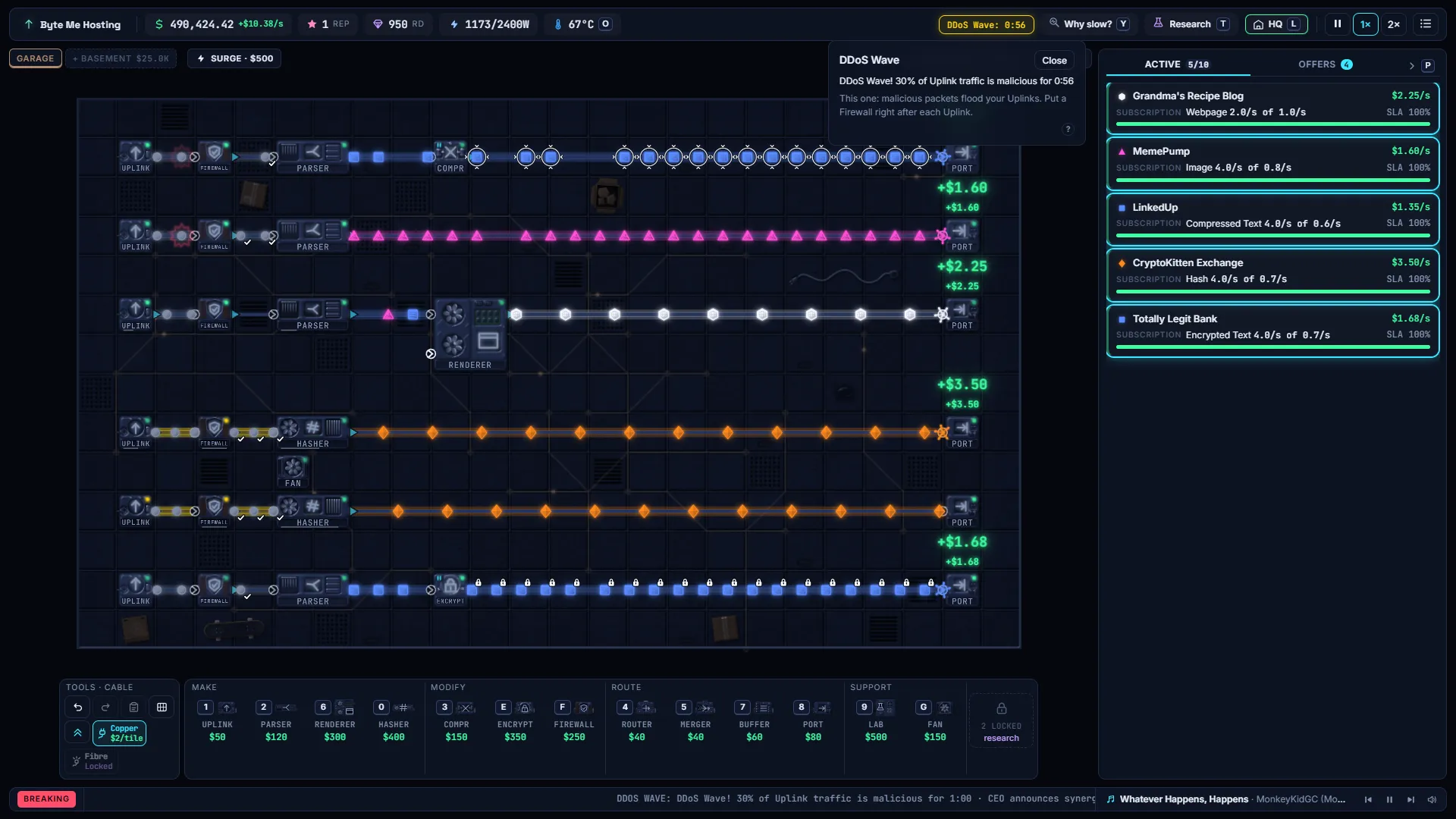
The Network Security node unlocks the Firewall, and its description carries a warning: “attackers will notice you (DDoS events).” That’s literal. DDoS waves only start once you’ve researched it, so the joke is the rule. During a wave, 30% of Uplink traffic turns malicious for a minute, and a Firewall right after each Uplink is the fix. During the 45-second warning you can also pay to be protected this time.
Grandma is the nicest client, and she got rebalanced
Grandma’s Recipe Blog wants Webpages, the hardest packet in the early game (Text and Image combined in a Renderer). Back when she was a subscription, she was paying two to four times more than any other client, so in v0.12.0 her pay was cut by 75%. Even Grandma isn’t above a balance pass. Her ladder now runs from The Lasagne Post to The Cookbook Deal (“400 recipes and 400,000 words of stories before them. She’ll sign with nobody but you.”), which only turns up once she’s as loyal as a client gets. She leaves lovely reviews, too: “Lovely young people. I’ve sent them a fruitcake.”
Your cousin, and the intern
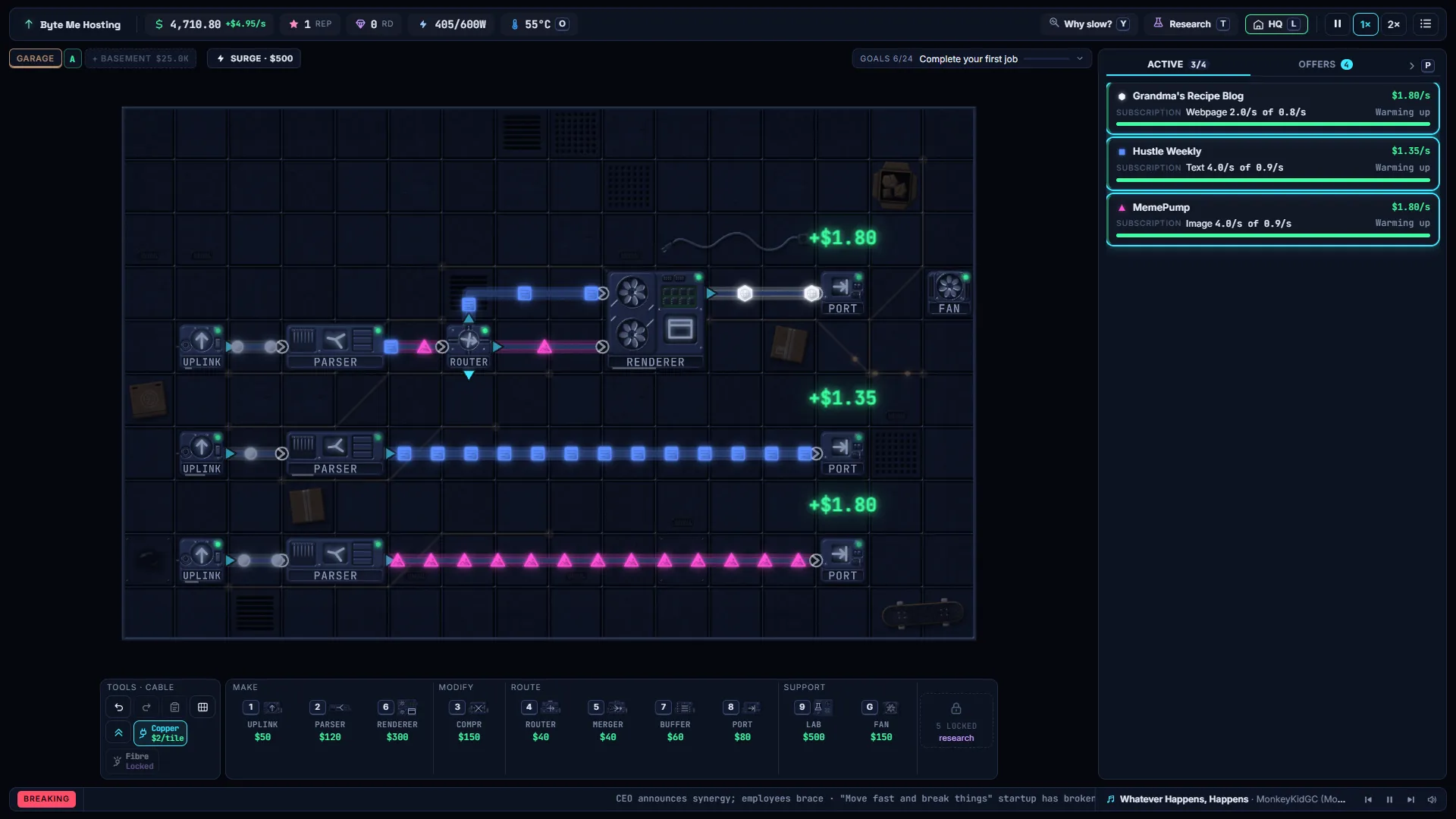
Your Cousin’s Startup is the first contract in every new game: 30 Text. The pitch is the satire: a startup that told its investors it was live before it had a single packet.
Your cousin also bought the building. Since v0.30.0 the game starts in Hyperbloat 2000’s old data centre, bought at auction, sight unseen: a dot-com that raised $400M and spent it on beanbags. The power company will only switch on one room, and the rest is dark and full of Hyperbloat’s leftovers. Hyperbloat’s liquidator and ex-staff write to you as well. One wants to know if their badge is still on their desk (“If you find a badge that says ‘Chief Vibes Officer’, you can keep it. It still opens the snack cupboard.”).
The Intern is a market event: a new hire is “just tidying the cables”, and one of your machines ends up unplugged until you plug it back in, for free. When it’s over, “The intern has been moved to the marketing team.” Nothing is destroyed and the Why slow? button points you straight at the culprit, so it stings for a moment and then it’s a joke.
A news ticker that reads your company’s name
A ticker runs along the bottom of the screen. Some of its lines are fixed:
- “Local startup pivots to AI for the 4th time this week”
- “Analysts confirm ‘the cloud’ is still just other people’s computers”
- “Man who bought one server now describes himself as ‘hyperscale’”
- “Tech influencer discovers the off switch, calls it ‘a game changer’”
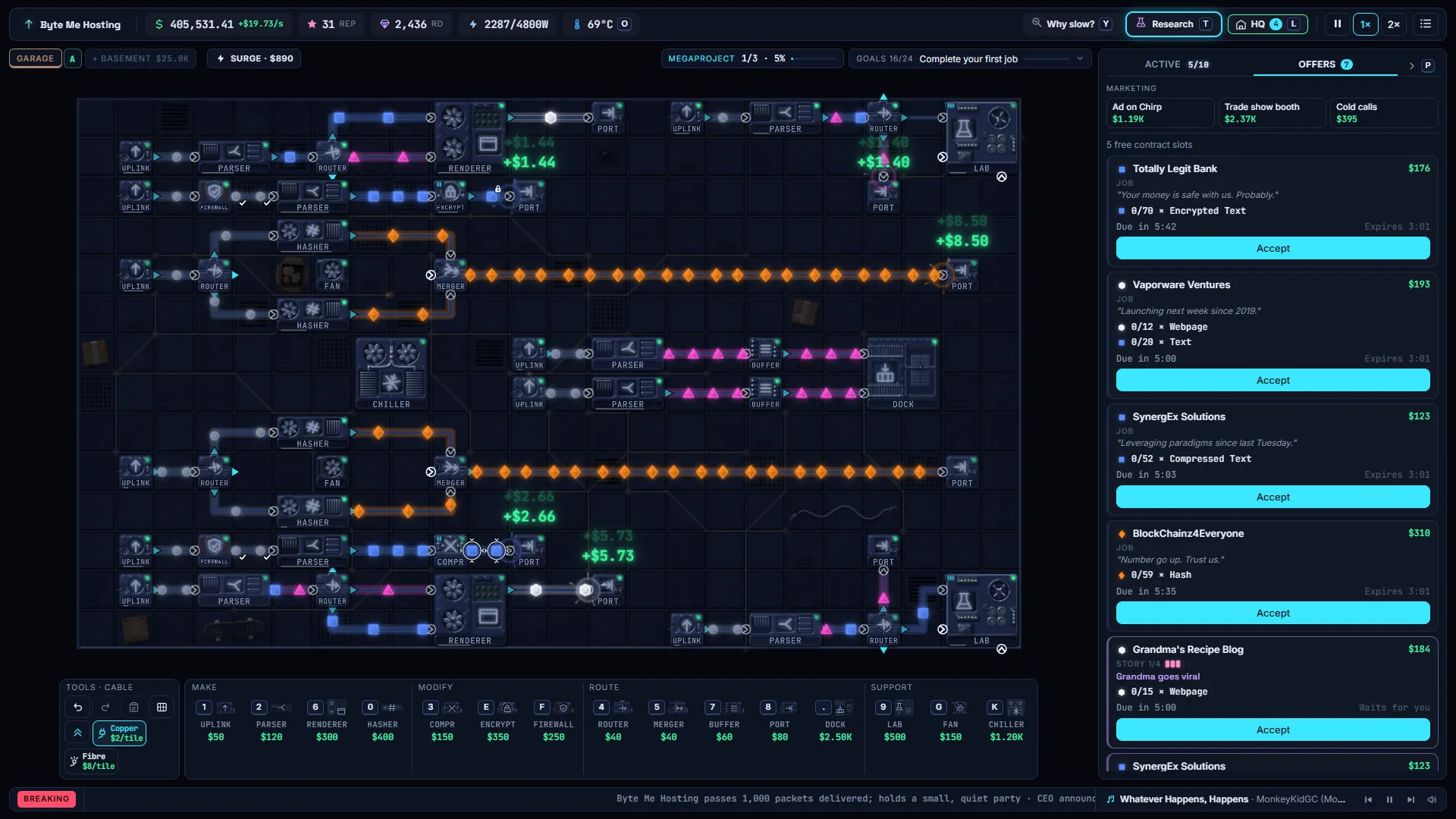
The better ones react to what you just did, using the name you gave your company. In my screenshots that’s Byte Me Hosting, so the ticker says things like “Byte Me Hosting passes 1,000 packets delivered; holds a small, quiet party”. A few more of the reactive lines, with “your company” standing in for the name:
- a power brown-out: “Local grid operator politely asks [your company] to ‘please stop’”
- powering up more of the building: “[Your company] switches on more floor; a Hyperbloat beanbag is found, still slightly warm”
- a missed deadline: “[Your company] misses Pixel Pantry deadline; calls it ‘agile’”
- your first Desk Fan: “Local firm discovers fans”
- ten minutes without touching the layout: “[Your company] enters ‘passive income era’, refuses to elaborate”
The ticker has manners. It shows at most one reactive headline every 15 seconds, each kind has its own cooldown, and “firsts” only fire once per save. Loading a save never sets off the milestone lines either, because the counters start from wherever you are.
An Inbox full of small decisions
Between contracts, mail arrives: 37 different emails in all. They arrive quietly. A count goes up on the HQ button and the ticker mentions it, but nothing pops up, because a standing rule of the game is to protect the flow.
Some are just jokes. A deposed “router of royal descent” needs your bank details and the admin password. Vaporware Ventures sends a launch update that reads, in full, “Still next week.” Grandma writes: “I have printed the internet out. The recipe is on page 212.”
About 40% carry a choice, and those have real trade-offs:
- Grandma wants her blog in Comic Sans and the licence costs a little. Pay it and she tells everyone at bingo about you.
- BlockChainz4Everyone offers a “quick gig, no questions”, paid “in a currency that exists today”. Take the money and a journalist’s email arrives with it: your reputation takes a hit.
- Your aunt says the electricity bill is “a bit much”. Chip in, or she starts unplugging things to boil the kettle, and pay is down for a while.
- Vaporware can’t pay your invoice and offers equity instead. Take it and you own 0.0001% of Vaporware.
Every button shows exactly what it does in real numbers, and ignoring a question is always safe: after ten minutes “they stopped waiting. Nothing happened.” My balance bot found the Inbox adds about 2 to 3.5% to income overall. It’s flavour with consequences, not a money printer.
Startups worth backing (some of them)
Once clients have paid you $10,000, fictional startups start pitching you through angel investing. There are 18 of them, including:
- ToastMatch: “A dating app for toasters. Swipe right for golden brown.”
- SockChain: “Every lost sock, on the blockchain. Forever.”
- NFTea: “Own a cup of tea. You can’t drink it.”
- Brick-as-a-Service: “Bricks, but monthly. Cancel any time (we keep the wall).”
- HiveStay: “Short-term rentals for bees. Hosts get paid in honey.”
- CloudCloud: “A cloud for your cloud. Backups of backups.”
Each pitch has a risk badge (Safe bet, Balanced or Moonshot) and pays back anywhere from nothing to four times the stake. Every profile averages a small gain, so it’s a bounded gamble. The results make the news: “SockChain goes bust; [your company] receives a heartfelt LinkedUp post instead.” The Venture Desk research lets you back one more startup at a time with bigger stakes, and the ticker notes that your founder “now says ‘synergy’ unironically”.
The small print: reviews, filenames and the Codex
The jokes go all the way down. Zoom right in and hover a packet to read its filename: definitely_not_passwords.txt, minutes_of_the_meeting_about_meetings.docx, screenshot_of_a_screenshot.png, top-10-routers-number-7-will-shock-you.html. Clients leave reviews (“Delivered early. I didn’t know that was allowed.”). The Codex fills in as you meet clients, packets and events, and every entry comes with a joke write-up next to your own numbers.
Names also come back across systems, which makes the world hang together. LinkedUp is a client, sends you an endorsement for “Being Near Cables”, and turns up in a startup’s bust headline. Chirp is a client and a place to buy ads. Grandma has a seven-step ladder, a storyline, a font crisis and a lasagne in the post.
How I keep it light
What I aim for, in short:
- Fictional companies only. No real businesses as clients, startups or targets.
- Aim at habits, not people. Hype, jargon, dark patterns and recipe preambles are fair game.
- Short enough for a card. One line, readable while your factory hums.
- Every joke points at a mechanic. The tagline hints at the packet; the event’s punchline is its rule.
- The player is in on it. The ticker teases your company, gently, and never stops you to do it.
All of it lives in one strings file, ready for translation, with tests that check every mail and headline has its text and its placeholders. More clients, storylines, events, mails and startup pitches are planned on the way to 1.0.
If you’d rather meet these people in person, the free demo starts you with your cousin’s first contract, and the beginner’s guide covers what to build first. For the real-world tech the jokes are built on, see how a data centre actually works.