Why I Removed Offline Earnings From My Idle Factory Game
Packet Empire used to pay you while it was closed. Offline earnings broke the economy, so v0.12.0 removed them. What replaced them, and what it cost.
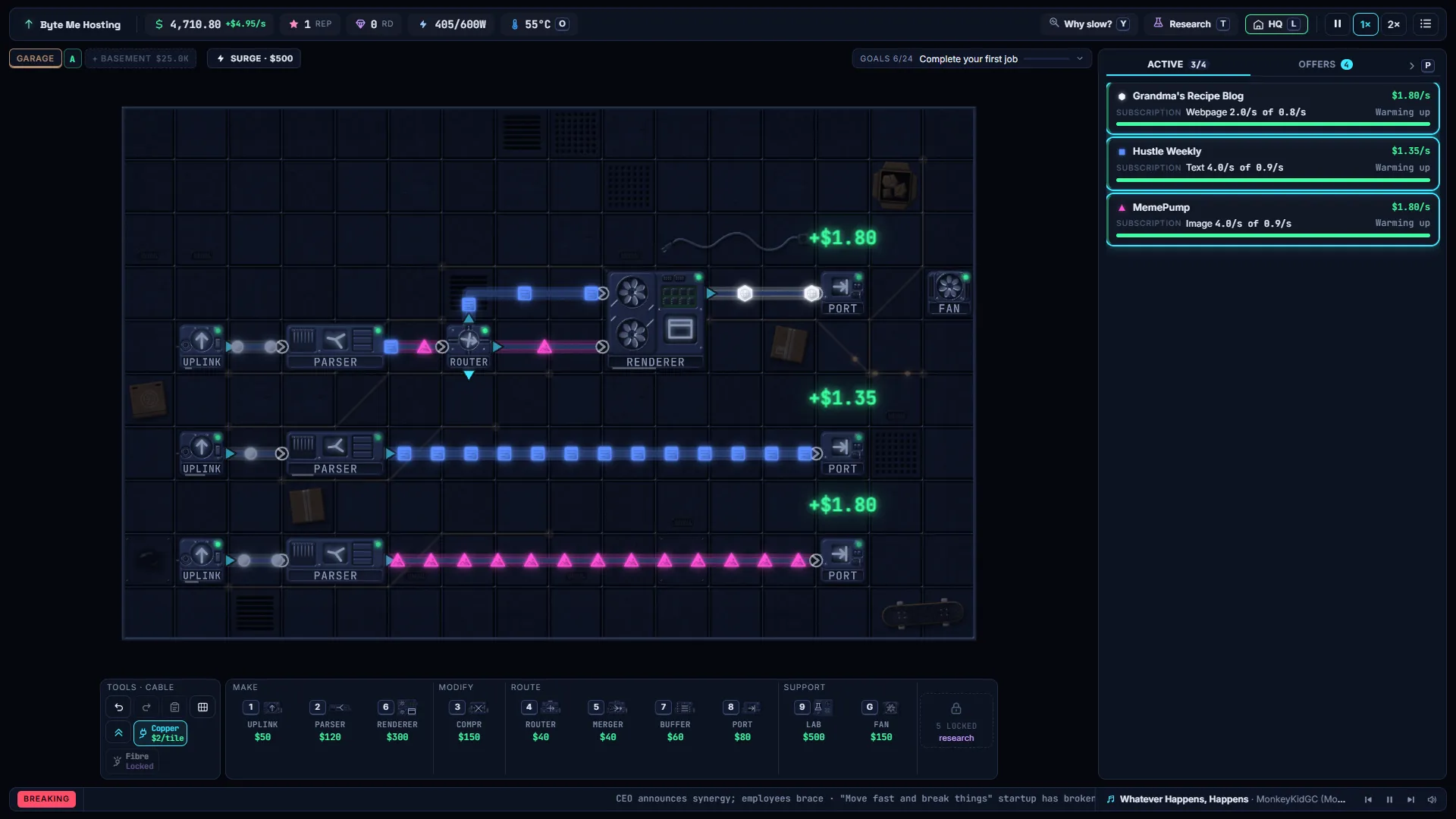
Packet Empire has no offline progress. Since version 0.12.0, “Spend it wisely” (3 October 2026), nothing happens while the game is closed: no income, no costs, no timers. I took it out because it broke the economy. One playtester came back to $8.2 million with nothing left to buy, and a tycoon game with nothing left to buy is over.
That’s a strange call for a game with an idle streak, so here’s the whole story: how offline earnings worked, why they failed, what replaced them, and what I gave up.
Updated 27 November 2026: since this was written, v0.29.0 replaced subscriptions with big staged contracts that pay per packet, and v0.30.0 replaced the Garage and the Basement with one building you power up section by section. The history below is as it happened; the parts about the game today describe it as it is now.
How offline earnings used to work
Offline progress was in from the very first build. Version 0.1.0 (30 September 2026) shipped with a line that read: “subscriptions keep paying at 50% while you’re away (up to 8 hours).” It was a deliberate choice. My design decision log for that day says “Offline earnings ON (capped, upgradeable)”, and the reason given is “idle retention hook”.
It grew from there:
- Always-On research pushed the rate up to 80% and the window up to 16 hours.
- A “While you were away” screen greeted you on load with what you’d earned.
- When the Basement arrived in v0.5.0, it brought rent, and rent was charged while you were away too (never below $0), so the screen had a cost line as well.
On paper this is the standard idle-game deal. Subscriptions were steady clients paying every second for a steady stream of packets, so why shouldn’t they keep paying overnight?
The $8.2 million problem
The answer came from a friend’s save. Two things had stacked up:
- Offline income. Hours of it, at a good rate, every time they came back.
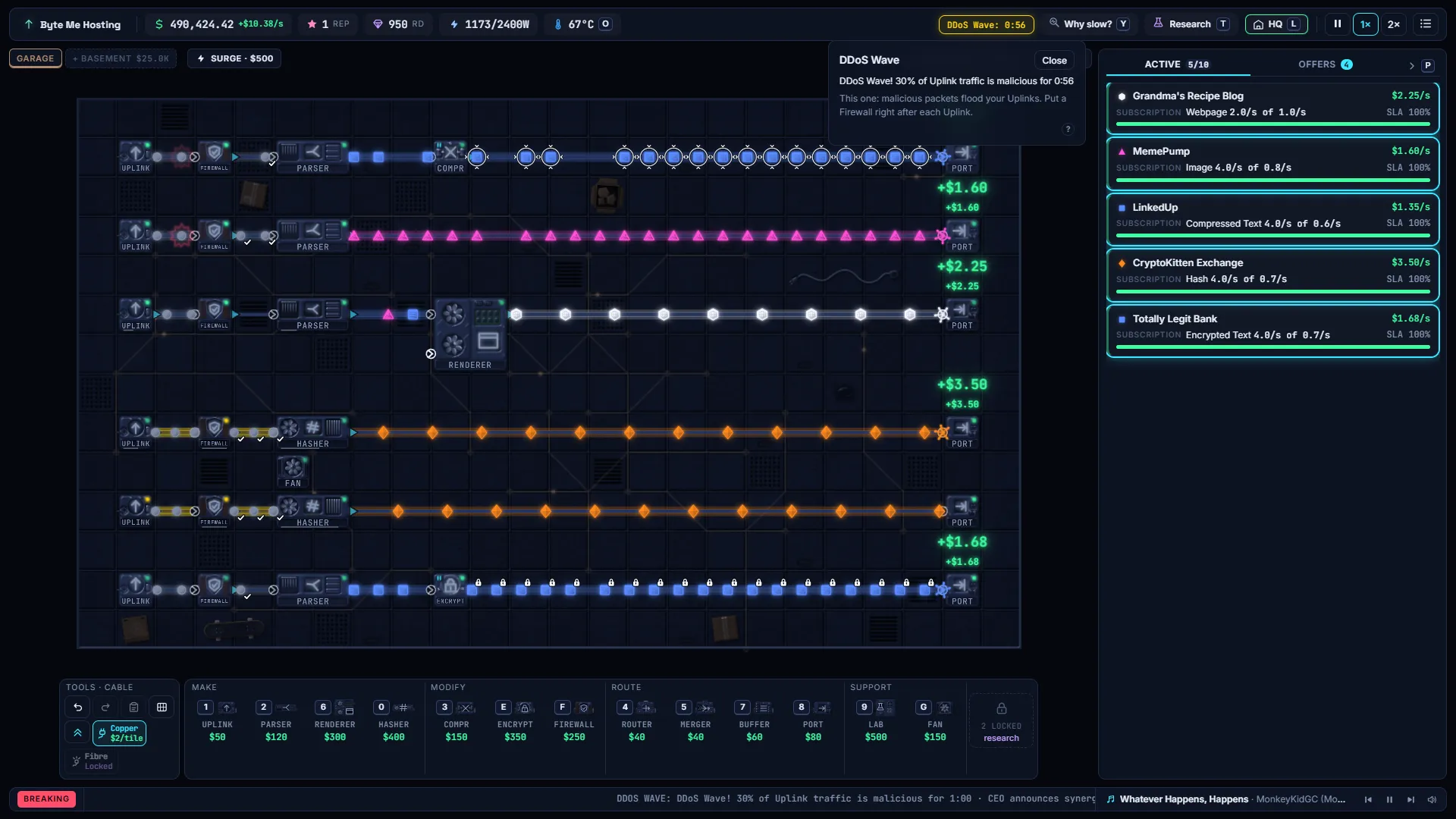
- An overpaid client. Grandma’s Recipe Blog (“Scroll past 4,000 words to find the recipe.”) wants Webpages, and her subscriptions were paying two to four times more than any other client. Set one up, close the game, go to bed.
They reached $8.2 million. For scale, the second floor, the Basement, cost $25,000 at the time. There was nothing left in the game to spend it on, and when money stops meaning anything in a tycoon game, the run is finished. Every machine is affordable, every upgrade is a click, and the thing that made you want to sit down and build is gone.
The second pillar of the game’s design is literally “Number goes up”: constant visible growth, always a next goal on screen. Offline earnings had turned that into “number went up while you weren’t looking”, which is a very different feeling. The growth happened off screen, and the decisions that should have produced it never got made.
Why remove it instead of nerfing it
The tempting fix is a smaller number: 25% instead of 50%, four hours instead of eight. I fixed Grandma that way (her subscriptions were cut to a quarter of what they paid, and the ones already running were adjusted too). For offline earnings, the decision was to remove them entirely, on 3 October 2026, three days after they shipped.
My reasoning, for what it’s worth: a smaller rate only slows down the same problem. Any offline income pays you for not playing, so the economy has to be balanced for two kinds of player at once, the one who plays and the one who closes the game and waits. Tune the prices for one and the other is either broke or swimming in cash. In a factory game, where the fun is building the thing that makes the money, I’d rather balance for the person who’s actually building.
The game also has a balance bot that plays the real simulation for hours and checks pacing targets. It never used offline time, so removing offline earnings didn’t change its numbers at all. Every pacing target I’d tuned, from the first research nodes to opening the Basement, was already built around active play. Offline money had been sitting on top of a balanced economy, pushing it out of shape.
What “nothing happens” actually means
“Nothing happens while the game is closed” is a rule I take literally, and it cuts both ways:
- No income. Clients only pay while the game runs.
- No costs. Nothing charges you for the hours you were asleep. (When the Basement had rent, that didn’t run either.)
- No timers. Contract deadlines, market events and angel investments only move with game time. A contract with nine minutes left still has nine minutes when you come back.
- No heat. Nothing heats up or breaks down while you’re away.
Under the hood this is simple, and that helps. The simulation runs at 20 ticks a second and never reads the clock. It only knows how many ticks have passed, so “closed” really is closed. The game still logs how long you were away, which is handy when someone sends a bug report, but that number never touches your money.
Two things carried over for older saves. Money already earned offline is yours to keep. And if you’d researched Always-On I or II, you got their replacements instead: ISP Partnerships and Venture Desk.
My design doc now puts it this way, under “Respect the player’s time”: the factory waits for you exactly as you left it. In other words, nothing punishes you for closing the game, and nothing rewards you for staying away.
Where the idle part went
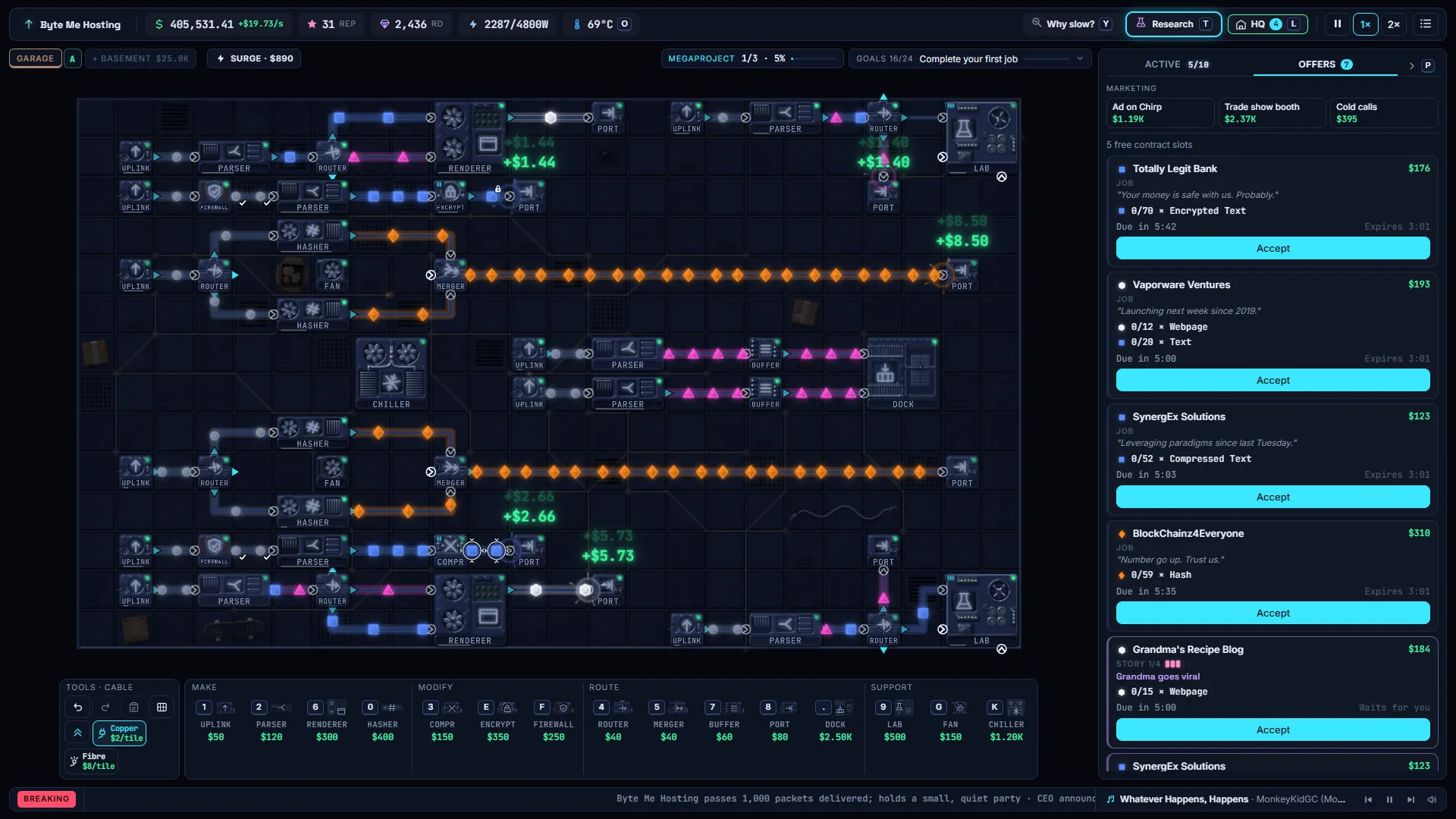
The idle streak didn’t disappear. It moved inside the session. Contracts are big orders now, and every packet pays the moment it reaches a Port. Build a line for a client who wants 1,500 Webpages and it earns the whole time it takes to fill, while you plan the next thing.
The problem v0.12.0 had to solve was what to do with that money while you wait. So the same update added things to spend it on and things to do:
- Floor upgrades. Every floor got its own shop: an ISP plan (Uplinks up to twice as fast), Insulation (less heat), LED lighting (less power draw), Better wiring (more power capacity) and Cable trays (cheaper cables). Each level costs 1.6 times the one before, so there’s always a next level worth saving for.
- Angel investing. Once clients have paid you $10,000, fictional startups start pitching: ToastMatch, SockChain, Goatly and friends. Back one and it pays back after a few minutes of play, anywhere from nothing to four times your stake. Only game time counts, to match the offline rule.
- Client reviews. Every finished, failed or abandoned contract gets a one-line star review.
Later updates kept filling the gaps. v0.17.0 “Hustle” added golden packets (a VIP badge drifts out of an Uplink every few minutes; click it for a bonus, miss it and lose nothing), side challenges whose timer only starts when you press Accept, and marketing campaigns. v0.22.0 “Think Big” added megaprojects: a giant billboard, a private undersea cable and a satellite, each funded in stages and fed thousands of packets through Shipping Docks. That’s where late-game money goes now.
And if you like the classic idle rhythm of leaving it running in a window, that works. The game drops to 10 frames a second whenever its window isn’t focused, so it won’t cook your graphics card. Ready pings chime and flash the taskbar button when you can afford research or the next section of the building. Settings has a Sound in the background switch if you’d rather it went quiet.
The trade-off, honestly
Removing offline earnings cost me things, and I’d rather say so.
- It’s less of an idle game. Some players love closing a game at night and opening it to a pile of money. Packet Empire won’t do that, and anyone who comes in expecting it will be disappointed.
- Closing it means pausing it. If you can’t leave the game running, you earn nothing while you’re away. That’s the point, but it’s still a cost.
- Some ideas died with it. Two ideas on my list were dropped the same day because they only made sense with offline time.
- The “welcome back” moment is gone. The old summary screen was a nice hook, and nothing quite replaces it.
What I got in return is an economy that holds together. Prices mean something, because nobody reaches the far corners of the building with millions in the bank. Research feels earned. And the game respects your time in the other direction too: walk away mid-build and nothing breaks, overheats or expires while you’re gone.
Nothing in Packet Empire runs on a real-world clock. That’s the rule, and every system added since has had to follow it.
Where to go from here
If you want to see how the in-session economy fits together, my beginner’s guide to playing Packet Empire walks through contracts, clients and your first lines. “Respect the player’s time” is one of five design pillars, and the post on why nothing is ever destroyed in Packet Empire covers the others: one-click repairs, undo, the calm start and the “protect the flow” rule. For the visual side of readability, there’s how every packet type got its own colour and shape.
Packet Empire isn’t out yet. It’s heading to Steam in Early Access in 2027, with a free demo (the lit room and the first ring of the building, about 75 minutes) arriving with the store page. The Packet Empire page has the details, and the Discord is where I post what’s changing.