Packet Empire Free Demo: What's In It, How It Ends and When You Can Play
The free Packet Empire demo is the lit room and the first ring of the building, about 75 minutes, and your save carries over to the full game. What's in it.
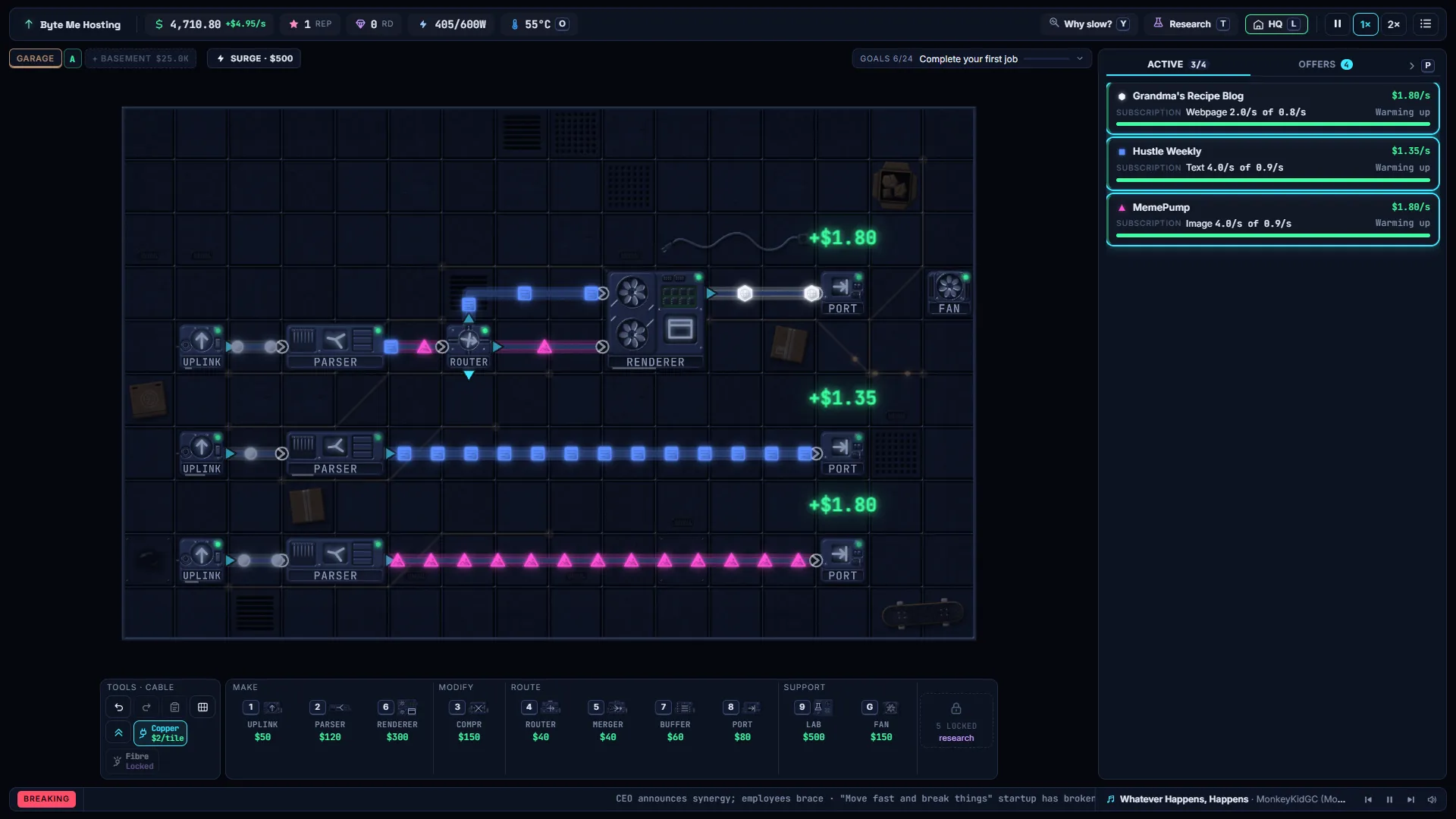
The free Packet Empire demo is the lit room and the first ring of the building, and takes a first-time player about 75 minutes. It ends on a proper card (“That’s the demo. Look what you built.”), you can keep playing afterwards, and your save carries over to the full game. It isn’t out yet: the demo arrives with the Steam page, ahead of Early Access in 2027.
The rest of this page covers exactly what’s in the demo, what’s locked, how the ending works and what happens to your save.
At a glance
| Price | Free |
| Platform | Windows PC, on Steam |
| Length | About 75 minutes for a first-time player, then keep playing as long as you like |
| What’s in it | The lit room and the 12 sections around it, 10 machines, 6 research nodes, 7 market events |
| Your save | Carries over to the full game |
| Release | With the Steam page, which is coming soon. Not out yet |
When can I play it?
Not quite yet. The demo is built, and it goes live together with the game’s Steam page. The full game follows in Early Access in 2027.
The first place I’ll announce it is my Discord. Wishlisting on Steam will work too, once the page is up.
On Steam it’s its own app, “Packet Empire Demo”, with its own saves, so it can never touch a full-game save.
What’s in the demo
If you haven’t met the game yet: Packet Empire is a factory and automation game crossed with a data-centre tycoon. You place machines on a grid, wire them with cables, and route glowing data packets to fictional clients who pay by the packet.
The lit room and the first ring
Your cousin bought a bankrupt data centre at auction, sight unseen. It belonged to Hyperbloat 2000, a dot-com that raised $400M and spent it on beanbags, and the power company will only switch on one room. You start in that room, 10×10 tiles in the middle of a dark 40×40 building, with $750, one Uplink already wired to a Parser, and your first client: Your Cousin’s Startup (“It’s like Uber, but for text files. Please help, I told investors we were live.”), who wants 30 Text packets. The room starts out cluttered with Hyperbloat’s leftovers (beanbags, a foosball table, a ficus, an old CRT) and tidies itself up as you earn.
Around it is the building’s first ring: 12 dark sections of 5×5 tiles. A padlock marks each one you can buy, any section that touches your land on a side, for $7,500 (less on Relaxed, more on Hard). Power one up and a light sweeps across it, the tiles switch on, and your floor grows. Own the whole ring and you earn the Lights On achievement.
Ten machines
- Uplink: where Raw packets come from.
- Parser: turns Raw into Text or Image (or alternates).
- Renderer: combines Text and Image into Webpages.
- Compressor: adds the Compressed modifier some clients insist on.
- Router and Merger: split and join traffic.
- Buffer: smooths out spiky flow.
- Delivery Port: hands packets to your clients.
- Research Lab: turns packets into Research Data.
- Desk Fan: your first answer to heat.
With Overclocking I you can upgrade machines to Mk II (1.6× the speed, 1.3× the power).
Six research nodes
| Research | What it does |
|---|---|
| Fibre Optics | Fibre cables carry 10 packets a second, twice copper’s 5 |
| Overclocking I | Mk II machine upgrades |
| Lab Equipment I | Research Labs upgrade to Lab Mk II |
| Sales Team I | Two more contract slots on the floor |
| Priority Accounts | Every client’s Priority chapter: bigger orders, mixes and rate holds, better pay |
| ISP Partnerships | The two fastest internet plans for your Uplinks |
Clients and contracts
The demo has the full contract system. Every client climbs its own ladder of hand-written contracts: staged orders with one deadline, exact mixes filled in sets at one Port, rates to hold on an SLA meter, and twists like Fragile packets that spoil on a long cable. Every packet pays as it lands, and finishing in time adds a bonus. There are repeat orders, rush jobs, storylines and client loyalty too. You’ll climb the Standard and Priority chapters of each ladder, from DataHoarders Inc. (“We don’t know what it is. We want all of it.”) to Grandma’s Recipe Blog (“Scroll past 4,000 words to find the recipe.”). The packets you’ll make are Raw, Text, Image and Webpage, plus Compressed versions of them.
Market events you’ll meet
Seven of the game’s nine market events can turn up in the demo:
- Viral Meme: Image pays double for a while, plus a rush job.
- Tech Journalist Visit: keep every running contract supplied for two minutes for a reputation boost.
- Influencer Shout-out: “Honestly? Underrated.” and a reputation boost.
- Competitor Outage: a rival host goes down and three of its clients land on your offer board.
- Power Surge: a few machines trip offline for 20 seconds, unless you pay for surge protection during the warning.
- The Intern: one machine gets unplugged until you plug it back in, for free.
- Solar Flare: every Uplink slows down for a minute, unless you pay for a backup link.
Every event is announced 45 seconds ahead. A new game’s first event is always a good one, and nothing harmful happens in the first 15 minutes.
Everything else that’s in
- The Inbox: satirical client mail, some with choices that cost or earn real money. Ignoring a question is always safe.
- Golden VIP packets: every few minutes one leaves an Uplink. Click it within 25 seconds for a bonus; missing one costs nothing.
- The office cat: Sudo by default (you can rename them), who naps on the warmest machine.
- A grade from A to F on the floor, with the top three things to fix.
- 22 goals, an in-game achievements screen with 16 to earn, and the Codex.
- The floor timelapse, undo and redo, box select, blueprints, Relaxed, Normal or Hard difficulty, the colour-blind packet palette and rebindable keys.
What’s locked, and still visible
Nothing is hidden. The rest of the game is there to look at, marked Full game:
- The rest of the building: the locks on the second and third rings read Full game instead of a price, and clicking one shows what the rest of the building holds: 48 more sections, all the way out to the 40×40 walls.
- The rest of the research tree: each locked node shows a dashed Full game chip and “Part of the full game. Your progress carries over.” That includes Mk III, the endless R&D tracks, the Enterprise chapter of every client’s ladder and the Venture Desk.
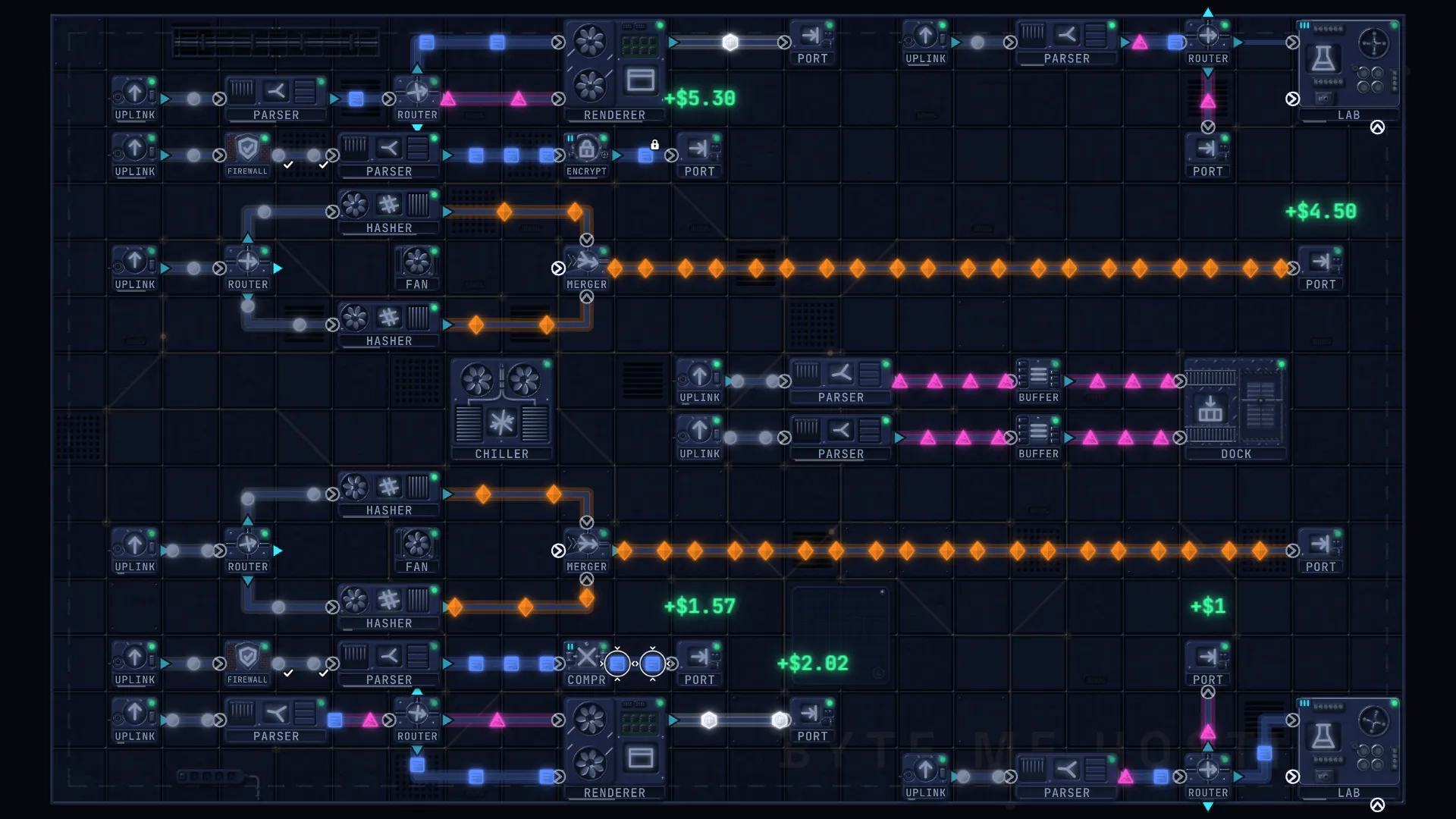
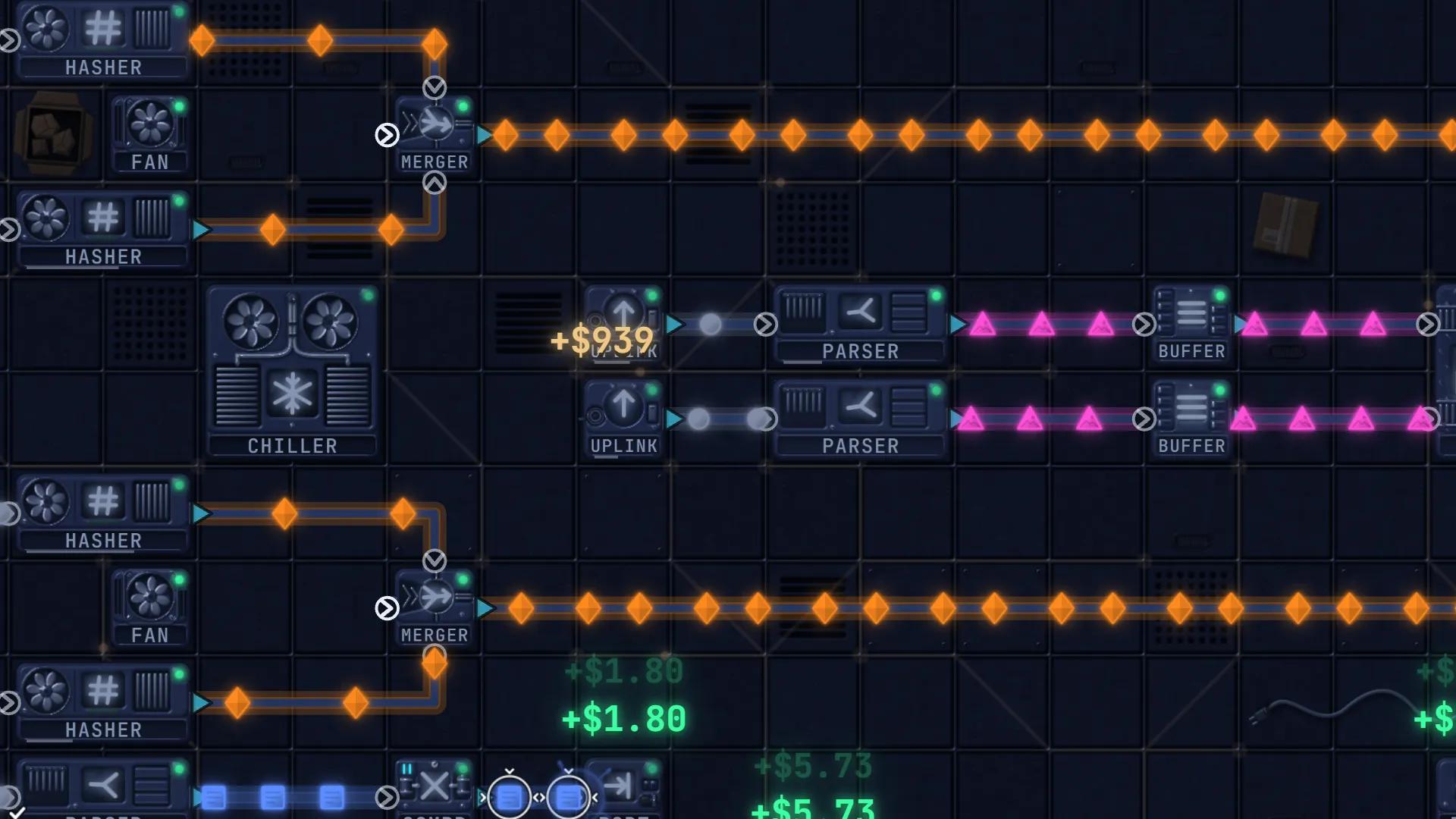
- Machines: the Hasher, Encryptor, Firewall, Chiller and Shipping Dock, along with Hash packets and the Encrypted and Validated modifiers that come with them.
- Events: Crypto Boom and DDoS Wave need research the demo doesn’t have.
- Late game: the three megaprojects (a giant billboard, an undersea cable and a satellite) and the automation research.
How the demo ends
The ending appears once, the first time either of these happens:
- you’ve researched all six demo nodes, or
- your clients have paid you $70,000 in total.
A card then opens: “That’s the demo. Look what you built.” It plays a timelapse of your floor coming together and lists your lifetime client income, play time, contracts done, best steady income, research done, best reputation and your cat’s name, along with what the full game adds.
Keep playing
The card has two buttons: Keep playing and Wishlist. Keep playing does what it says. The game keeps running, your lines keep filling contracts, and you can push for an A grade, finish the goals, power up the rest of the first ring, or rebuild the whole floor more neatly. The demo’s limits stay in place. A Demo complete chip above the floor brings the card back whenever you want to look at it again.
Your save carries over: “Bring your Data Center over?”
When the full game launches and finds demo saves on your PC, the main menu asks once: “Bring your Data Center over?”
- Each demo save goes into the first empty save slot, with its picture. If all three slots are full, you’ll need to free one first.
- The demo’s own file is copied, never touched, and you can bring saves over later from the main menu’s Demo saves button.
- Play it and the limits lift: a “Welcome to the full game” banner, the rest of the building for sale, the whole research tree open.
- Achievements you earned in the demo unlock on Steam the next time the full game checks.
Two small exceptions: the demo keeps its own settings, so your blueprint library stays with the demo, and the demo can’t open a full-game save.
Tips for your first run
- Your cousin wants Text. Check what that starter Parser is set to.
- Build a Research Lab early. Finishing the demo’s research is one of the two ways to reach the ending, and the Lab feeds it.
- Watch the heat. Machines packed tight run hot and slow down. The heat overlay shows where, and a Desk Fan helps.
- Use Why slow? It points at whatever is holding your floor back, including a machine the intern unplugged.
- Nothing is ever destroyed. An overheated machine breaks down and takes one click to repair, so experiment freely. (Here’s why I designed it that way.)
The beginner’s guide covers your first lines step by step.
Quick answers
Is the demo really free? Yes.
How much will the full game cost? $9.99 USD in Early Access.
Does anything happen while the demo is closed? No. There are no offline earnings, by design: your floor waits exactly as you left it.
Is it on Steam Deck? Not yet. Steam Deck and controller support are planned for the full game.
Is the demo a separate version of the game? It’s the same game with limits stored in your save, which is why lifting them later is so simple.
More questions are answered in the Packet Empire FAQ. If you like the sound of the clients, the stories behind them are in how I write satirical tech clients.