Nothing Is Ever Destroyed: Designing a Cozy Factory Game With No Fail State
How I made Packet Empire a cozy factory game with no fail state: one-click repairs, an A to F floor grade, undo, three difficulties and a calm start.
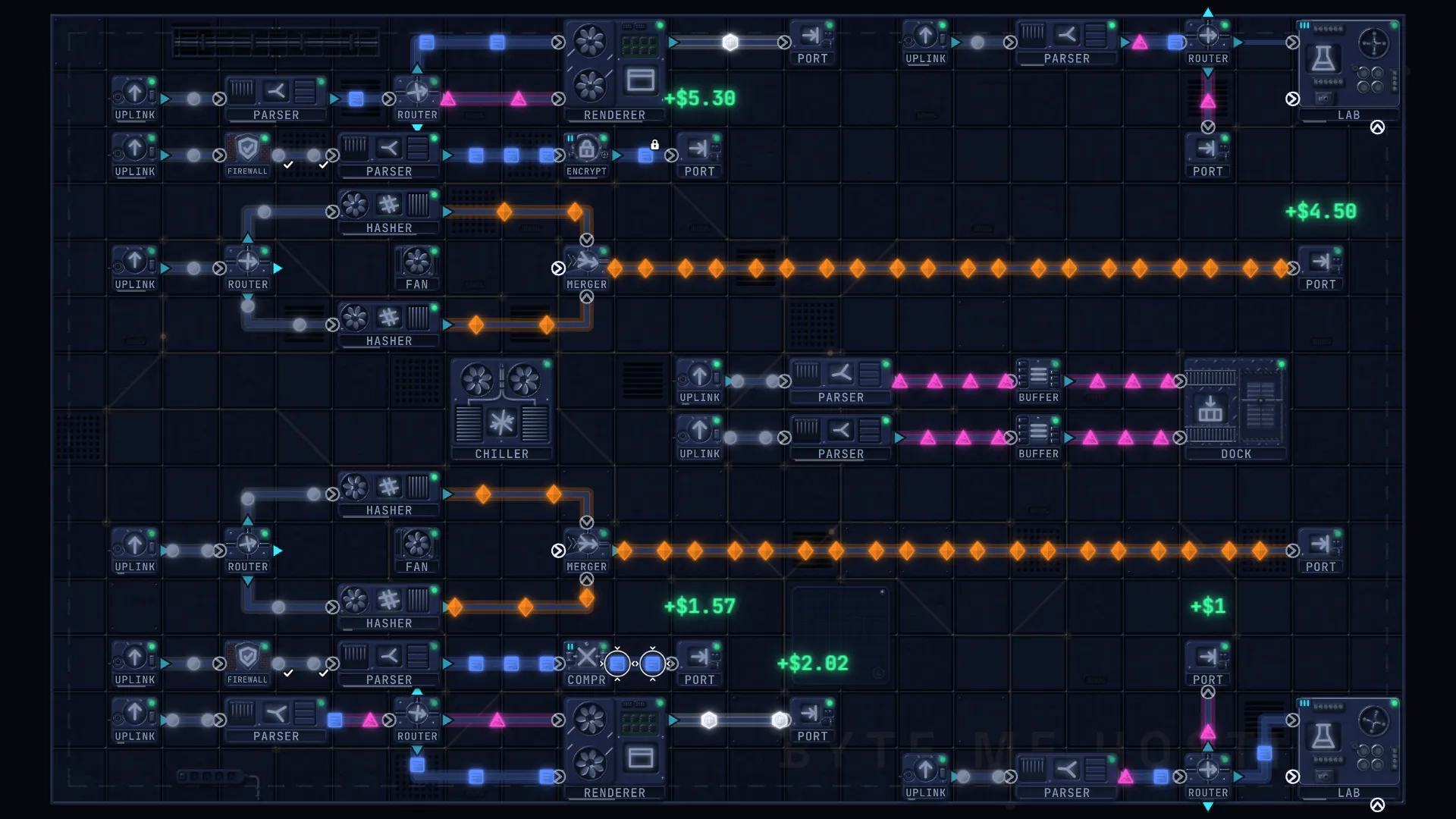
Packet Empire is a factory game with no fail state. Machines can overheat and break down, but a breakdown is one click to repair, and nothing is ever destroyed. Money never drops below zero, a missed deadline costs a bonus and some reputation but never cash you have, and when you close the game your factory waits for you exactly as you left it. You can lose a client. You can’t lose the game.
None of that is an accident. It comes from five design pillars written into the game’s design document at the start, and from one rule a friend handed me by accident during an early playtest. This post goes through them, with the actual numbers.
The five pillars
The game’s design document opens with them, followed by a blunt instruction: every feature must support at least one pillar, and if a feature supports none, cut it.
- Hypnotic flow. Watching packets stream through a network you built is the core pleasure, so it has to look and sound great.
- Number goes up. Constant visible growth, and always a next goal on screen.
- Readable complexity. Deep systems, but you can always tell why something isn’t working.
- Respect the player’s time. Nothing gets permanently destroyed, no punishing fail states, and the factory waits for you.
- Light satire. A sleek, serious look, while the clients, events and news ticker poke fun at the tech industry. Every company is fictional.
Pillars three and four do most of the work of making a factory game feel cosy rather than stressful, so most of this post is about them.
Breakdowns cost a click, not a factory
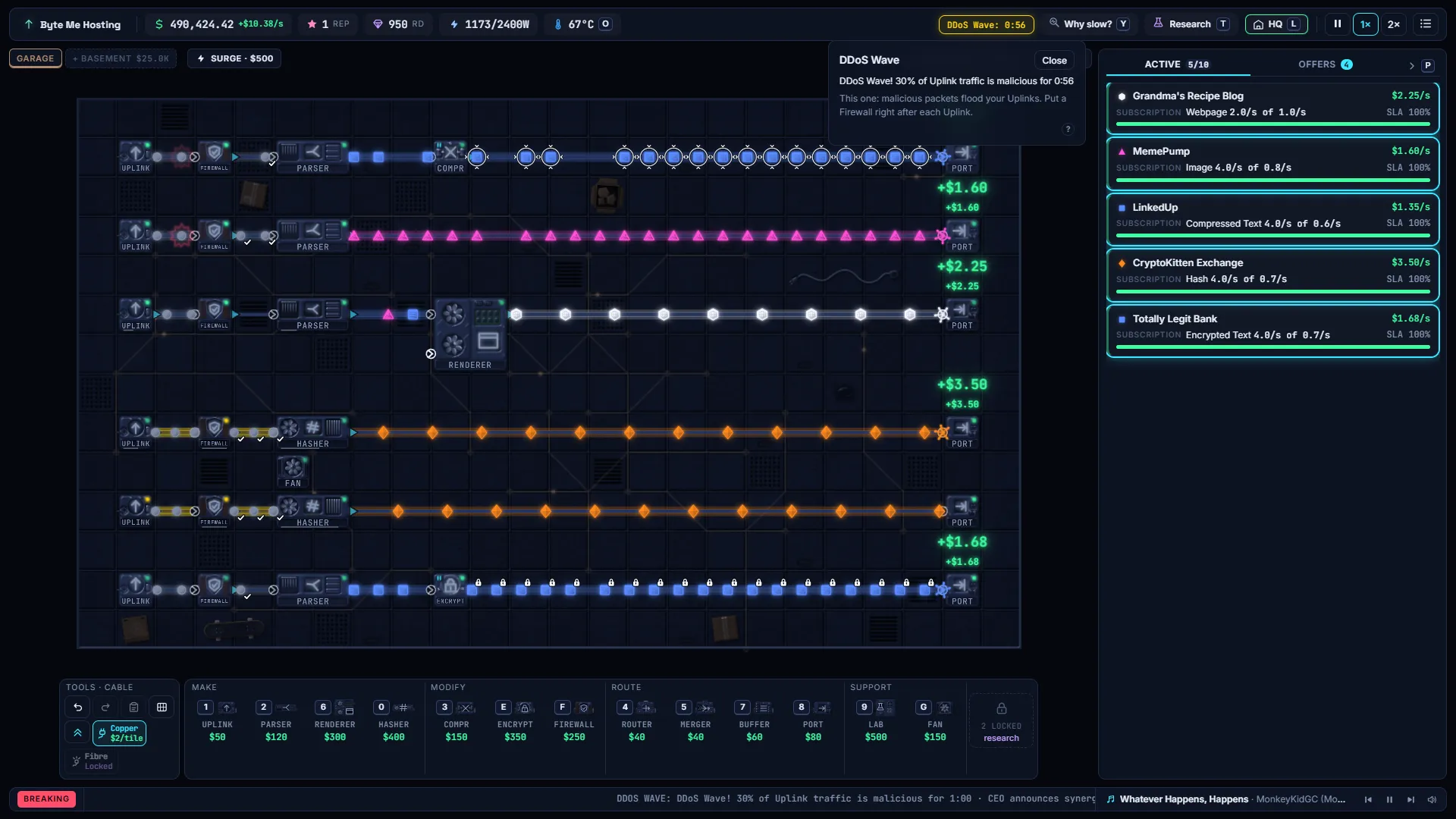
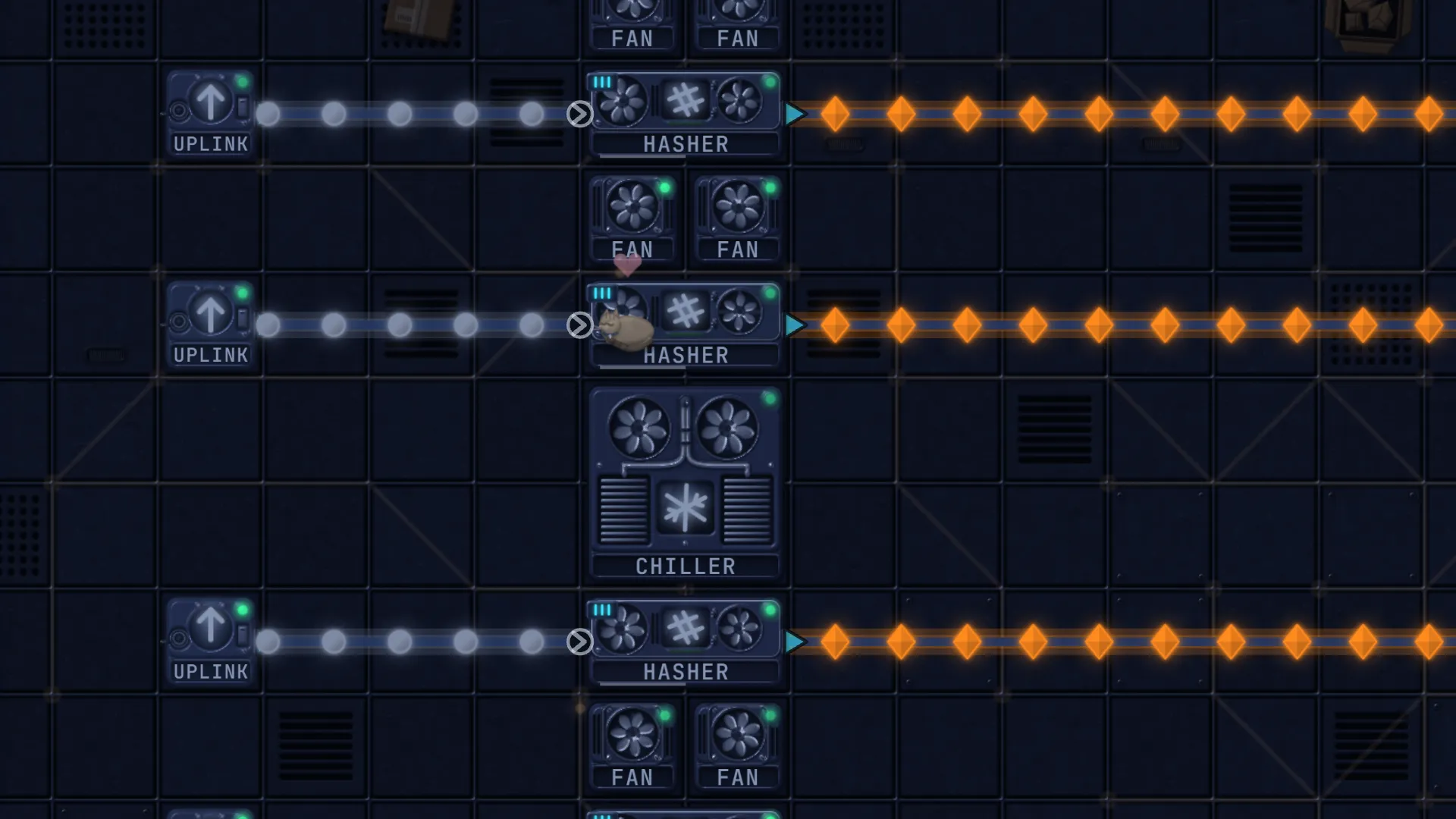
Heat is the system with the most potential to punish. Every machine has a temperature, made of its own power draw plus whatever is packed in next to it, and upgrading to Mk II or Mk III makes it run hotter. Above 70 °C a machine slows down, reaching half speed at 90 °C. At 90 °C and above it can break down, with a small chance every second that climbs the hotter it gets.
What a breakdown does is deliberately limited:
- The machine stops, its light blinks red, and it looks scorched and throws the odd spark, so you can spot it from across the floor.
- Repair is one click in its panel, or Repair all in the top bar. It costs 20% of what the machine cost, cheapest first if you’re short.
- It isn’t destroyed. Your cables, settings and upgrades are all still there.
- Late in the game, researching Maintenance Bots gets broken machines repaired for you once they’ve cooled down.
The same thinking runs through the rest of the economy. Removing a machine refunds 100% of its price, so experimenting is free. Money stops at $0 instead of going into debt (an early design had debt with interest, which was never built). Missing a contract’s deadline costs its finish bonus and a little reputation, never money you already have: every packet you delivered stays paid, and the client comes back later to try again.
Problems explained on the thing that’s broken
“I didn’t understand why it wasn’t working” is the review I most want to avoid. Factory games are full of quiet failures, a line that’s backed up three machines away from the symptom, and the fix for that is to say what’s wrong, in words, on the thing that’s wrong.
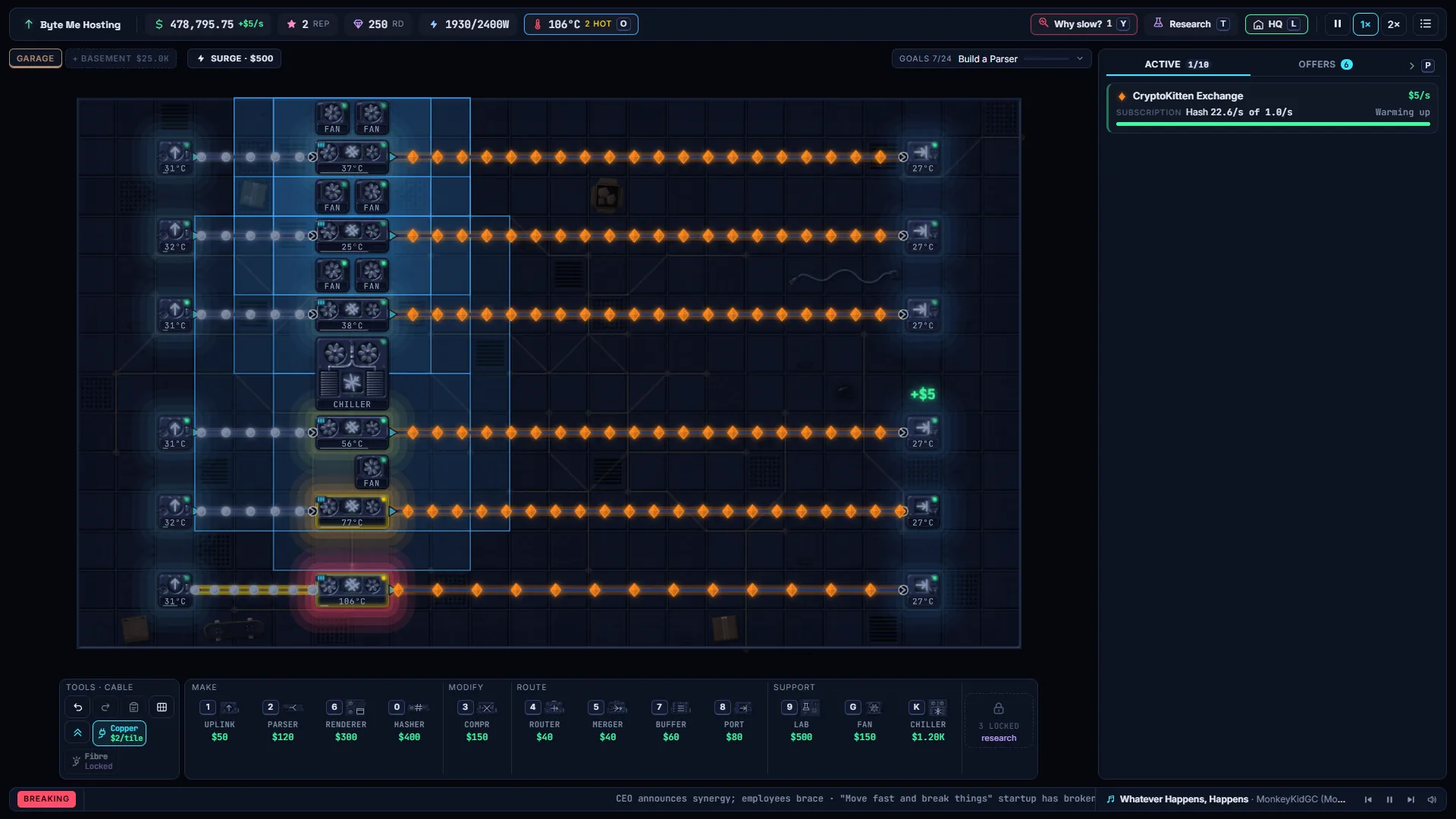
- “Why slow?” looks at the floor you’re on and names the one thing actually holding it back, in plain English: a Port refusing packets, a machine with nowhere to send its output, a Renderer with no Image source, a full cable, a brown-out. Show me jumps the camera to it and selects it. The rule behind it: a wrong diagnosis is worse than none, so it only claims a cause it can prove from the floor’s state.
- It only lights up for real problems. A full cable that’s still keeping every client happy is a note, not a warning.
- Its message points at the thing it’s talking about: the machine, the cable, the power reading or the contract’s card, with a pulsing ring on the floor.
- The machine panel leads with what’s wrong and how to fix it, before the stats.
- Placement previews warn you before you build. Hold a machine over the floor and it shows how hot it will run and whether it would throttle, push a neighbour past 70 °C or brown out the floor.
A grade, not a verdict
For players who like to optimise, v0.20.0 added a letter from A to F beside the floor’s name, above the floor. It’s based on the last minute of play and scored out of 100, with points taken off for five things:
| What costs points | Weight |
|---|---|
| Idle machines | 25 |
| Brown-out | 25 |
| Heat | 20 |
| Full cables | 15 |
| Stuck packets | 15 |
An A needs 90 or more, a B 80, a C 65, a D 50. Click the letter and you get a bar for each part and the top three things to fix, each with a Show me or a button that takes you to the right screen.
The grade card never opens by itself, and it ends with a reminder I mean: a C floor that pays the bills is fine. The grade is something to tinker towards if you enjoy that, not a judgement on how you play.
Undo everything, keep your best ideas
Cosy building means you can try things without fear. Packet Empire’s building tools are built around that:
- Undo and redo, up to 50 steps, including removals. Delete a machine by mistake and undo brings it back with its cables and upgrades. Because removal refunds in full, an undo is money-neutral.
- Move and rotate anything after it’s placed, and its cables re-route themselves.
- Box select, copy and paste whole production lines, settings and cables included.
- A blueprint library: save a layout you like, name it, and paste it again later in this game or any other save. Each one shows a small map, a rough price and any research you still need.
Pick your pressure: Relaxed, Normal or Hard
Some players want no breakdowns ever. Others want the game to push back. Since v0.18.0, New Game asks.
| Relaxed | Normal | Hard | |
|---|---|---|---|
| Breakdowns | never (machines still slow down when hot) | as designed | twice as often |
| Harmful events | rarer and milder | as designed | more often and harder |
| Time between events | as designed | as designed | 20% shorter |
| Land prices | 25% lower | as designed | 50% higher |
| Client pay | as designed | as designed | 5% more |
A few deliberate choices sit behind the table. Relaxed keeps heat throttling, because heat is still a good puzzle; it just can’t break anything. Hard pays a little more so it’s a choice, not just a penalty. Normal is exactly the game as it was before difficulty existed. And the setting is fixed for each save, so it can’t be flipped to dodge an incoming event.
A calm start
The first fifteen minutes decide a lot of reviews, so they get special treatment.
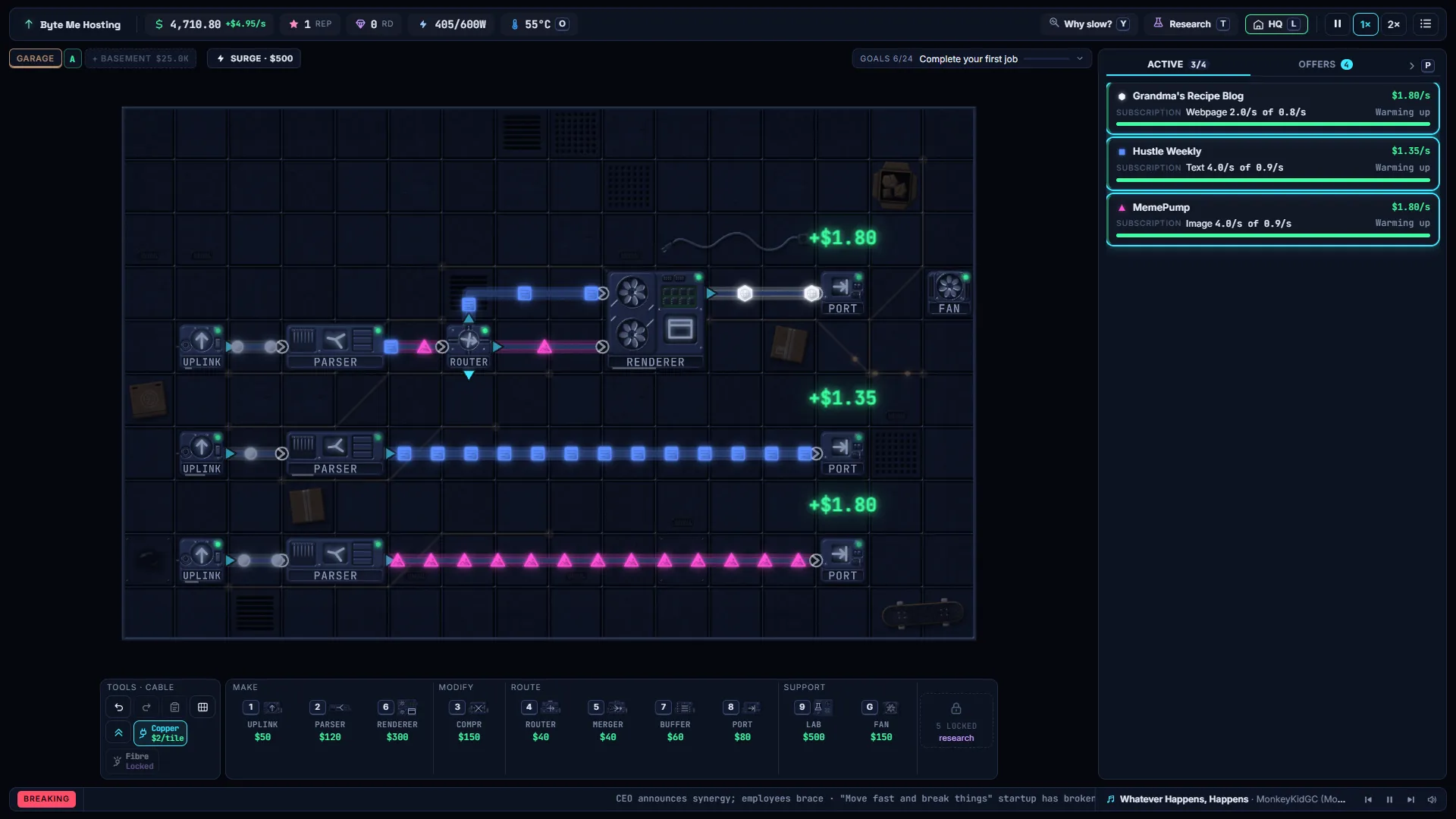
A new game doesn’t open on an empty grid. It opens on your cousin’s half-built line with packets already flowing; his Parser makes the wrong packets and has nowhere to send them, and the tutorial starts with you fixing it.
Then there are market events. Before v0.23.0 “First Impressions”, about four in ten new games got a harmful first event. The Intern could unplug one of your machines at minute five, before you’d really learned what a machine was. Now a new game’s first event is always a good one, a Viral Meme, an Influencer Shout-out or a Competitor Outage, and nothing harmful happens in the first 15 minutes. Crypto Boom is left out of that friendly pool on purpose: it rewards Hashers, which a new player doesn’t have yet, so it would teach nothing.
Protect the flow
In an early playtest, a friend lost an hour in the game. That’s the feeling I’m building for: the hum of a factory you made, the next small improvement always in reach. It became a standing rule, written at the top of my list of next steps: protect the flow. No new interruptions, and every new feature gets checked against it.
In practice that means new things appear on the floor, in the goal pill or on a card, and only results get a pop-up. Some of what it shaped:
- Mail arrives quietly. The Inbox shows an unread count and the news ticker mentions it, but nothing pops up. Some mails ask you to choose, and ignoring one is always safe: after ten minutes they stop waiting and nothing happens.
- Golden packets drift out of an Uplink every few minutes as a bonus. Missing one costs nothing.
- Side challenges sit next to your goals, and their timer only starts when you press Accept.
- Market events are announced about 45 seconds ahead, with one message. The harmful ones can be bought off during the warning for roughly 45 seconds of income.
- Tips wait until you’re done. Since v0.26.3, “Not Now”, a tip that comes up while you’re building, dragging a cable or reading a machine panel holds off until you’ve finished.
- The music player fades a new song’s name in once, with no pop-up.
The rule also killed ideas. I considered a competitor company that would steal your clients in the late game. It would have interrupted and punished, so it was dropped. If a rival ever shows up, the idea is one you race rather than one that raids you.
Offline earnings went for a related reason: they bent the economy around players who weren’t playing. That story has its own post on why I removed offline earnings.
The other three pillars, briefly
Hypnotic flow is mostly about restraint. Packets are the only bright thing on screen, working machines spin their fans while idle ones stand still so you can spot them, and the soundtrack has a calm song, Night Shift, for long stretches of watching the factory run itself. The colour rules behind that are in how every packet got its own colour and shape.
Number goes up is the +$ pop-up over every Port that gets paid. The style guide calls it the main dopamine hit and says it must never be faint. A goal pill above the floor always shows the next thing to aim for.
Light satire is the clients. Totally Legit Bank (“Your money is safe with us. Probably.”) wants encrypted Text. Your Cousin’s Startup is “like Uber, but for text files”. The news ticker reports on your company, mostly kindly.
Where the tension comes from
No fail state doesn’t mean no stakes. Every contract has a hard deadline, and missing it costs the finish bonus and some reputation. A go-live stage has an SLA meter that drains when you fall behind, and if it empties the hold starts again. Go over your power plan and the whole floor browns out and slows down. Each ring of the building costs more than the last. Heat throttles your best machines exactly when you’ve upgraded them.
The difference is that every one of those is a problem you can fix, explained on the thing that’s broken, and none of them wipes out what you’ve built. If you want sharper teeth, Hard is there. If you want none at all, Relaxed is.
To see how it plays from the first cable, the Packet Empire beginner’s guide walks through your first lines. Packet Empire is coming to Steam in Early Access in 2027, with a free demo (the lit room and the first ring of the building) when the store page opens. The Packet Empire page has the rest.