The Best Data Center Games on PC in 2026: Server Sims, Tycoons and a Factory
The best data center games on PC in 2026: first-person server simulators, data centre tycoons and one top-down factory take, with who each one suits best.
If you want a data center game on PC right now, start with Data Center by Waseku for hands-on racking and cabling, Uptime: A Cloud Provider Sim if you want the networking to be properly nerdy, and COLD AISLE: Data Center Tycoon or Server-Admin Simulator if you’d rather run the business than crimp the cables. Tower Networking Inc. is the odd one out, and the best of the lot if you like a roguelike.
Full disclosure: I make Packet Empire, on my own. It’s in here, marked as mine, in its own section at the end; the rest are games I’d recommend anyway.
The genre has had a real boom over the last two years. Most of the new arrivals are first-person: you walk the aisles, slide servers into racks and run cables by hand. A smaller group are management games where you mostly look at contracts, staff and spreadsheets. I’ve sorted them that way, because it’s the first thing to decide.
At a glance
| Game | Developer | View | Status (Nov 2026) | Best for |
|---|---|---|---|---|
| Data Center | Waseku | First-person | Released | Building and cabling by hand |
| Uptime: A Cloud Provider Sim | RubyRack Games | First-person | Early Access | Real networking concepts |
| Cloud Server Simulator | Realityocean Games | First-person | Early Access | Terminal lovers |
| Web Host Simulator | Chibum | First-person | Early Access | Starting from a flat |
| Basement Server Simulator | StiGMaT Games | First-person | Demo, not out yet | Relaxed co-op hosting |
| COLD AISLE: Data Center Tycoon | Velmirestudios | First-person | Released | Contracts and rivals |
| Server-Admin Simulator | Ice Phoenix Studios | 2D | Released | Classic tycoon with a story |
| Tower Networking Inc. | Pocosia Studios | 2D | Early Access | Roguelike ISP runs |
| Network Engineer Simulator | Walrus Game Studio | First-person | Not out yet | Tidying cable spaghetti |
Status and details are from each game’s Steam page in November 2026. Early Access games change fast, so check the page before you buy.
First-person rack-and-cable sims
These are for people who want to be in the server room. Expect physical hardware, a lot of cable, and the slow satisfaction of a tidy rack.
Data Center (Waseku)
Data Center released on 31 March 2026 and is the purest version of the idea. You start with bare floors, buy racks, servers and switches, stack them where you like and connect everything with Ethernet cables by hand.
The clever bit is that customer traffic is visible: coloured packets move along your cables, one colour per customer, so you can actually see congestion and capacity rather than reading about it in a menu. Hardware ages and fails, which pushes you towards redundancy: extra links, alternate paths, spares on the shelf.
Best for: players who want the data centre fantasy as literally as possible, with the network made visible.
Uptime: A Cloud Provider Sim (RubyRack Games)
Uptime: A Cloud Provider Sim entered Early Access on 17 July 2026, and it is the most technical game on this list in a good way. You go from a single server in a garage to a data centre floor, racking hardware and running cables with typed connectors and patch panels, but the depth is in what runs on top: virtual machines, storage, databases and Kubernetes, each with its own control plane.
The store page lists switching, spanning tree, oversubscription, fault domains and BGP among the things it simulates, plus DDoS floods that grow with you. There’s a jargon toggle and difficulty settings for newcomers, and, a lovely touch for the target audience, a read-only local HTTP API with a Prometheus /metrics endpoint so you can graph your fake cloud with real tools. It runs on Windows, macOS and Linux, and multiplayer is still in beta.
Best for: people who work in IT and want a game that speaks their language.
Cloud Server Simulator (Realityocean Games)
Cloud Server Simulator has been in Early Access since 22 September 2025. You run a warehouse of racks, configure servers and handle client contracts, but its signature feature is a Unix-like terminal and file system: a lot of the work happens by typing commands.
It also takes physical upkeep seriously. Servers that overheat or gather too much dust break down, so cleaning the warehouse is part of the job. The developers list dynamic network cabling and a deeper terminal among the plans for the full release.
Best for: players who’d rather type ls than click a button.
Web Host Simulator (Chibum)
Web Host Simulator went into Early Access on 6 August 2025 and starts smaller than most: a hosting company run from your little apartment. You sell VPS and dedicated servers, assemble hardware, and use both graphical and command-line operating systems inside the game.
It has an in-game internet with websites you can browse, and cable management with real-time physics, which is either soothing or a nightmare depending on your relationship with real cables. The developers expect a long Early Access (around two years), so it’s one to follow as much as one to play.
Best for: a slower, homelier start to the hosting fantasy.
Basement Server Simulator (StiGMaT Games)
Basement Server Simulator isn’t out yet: the store page lists a 2026 Early Access release and a demo you can play now. You turn a home setup into a basement hosting business, alone or in co-op, buying new or used hardware, installing server apps, setting prices and taking time-limited contracts while keeping power, internet and heat in check.
The page is upfront that it’s designed to be relaxed and doesn’t expect real networking knowledge, which makes it a friendlier entry point than Uptime or Cloud Server Simulator.
Best for: co-op with a friend who doesn’t know what a subnet is.
Management and tycoon games
Less cable, more contracts. These are about running a data centre business: who you sign, who you hire, and how close to the edge you run the power.
COLD AISLE: Data Center Tycoon (Velmirestudios)
COLD AISLE: Data Center Tycoon released on 28 August 2026. It’s first-person, but its heart is management. You start in an empty industrial hall, order hardware, take deliveries, install servers and GPUs, and connect power, network and cooling. The systems feed into each other: circuits overload, equipment wears out and SLA violations cost you.
Where it stands out is the business layer. You negotiate contracts on price, duration, capacity, peak load, service level and penalties, compete against 32 rival companies and can buy hardware from insolvent rivals’ liquidations. A second market for simulated AI products competes with your hosting customers for the same compute, which is a sharp little bit of design. There’s a demo.
Best for: tycoon players who want negotiation and rivals, not just building.
Server-Admin Simulator (Ice Phoenix Studios)
Server-Admin Simulator released on 18 September 2026 and is the most traditional tycoon here, in 2D. You begin with one server in a rented closet and grow into a full data centre, buying hardware, taking contracts, hiring four kinds of staff (cooling, security, network and sysadmins) and managing loans while rivals poach clients and random events cause outages.
It has a 13-mission branching campaign with two endings: a legal one, and an “underground” one with a hacking minigame and a Zero-Day exploit market. There’s also an Endless Mode, New Game+, co-op or competitive multiplayer for up to four players, and an official mod SDK. A demo is available.
Best for: players who want a story and a moral fork with their server racks.
Something different: Tower Networking Inc.
Tower Networking Inc. (Pocosia Studios)
Tower Networking Inc. has been in Early Access since 30 July 2025 and isn’t strictly a data centre game: you’re an internet provider for a randomly generated tower that keeps growing new floors. Each floor brings homes and offices with their own needs, and you patch cables between switches, routers and data risers on a tight budget.
It’s 2D, it has a command-line interface for tracing connections and installing server apps, and it has roguelike teeth: if a client with an SLA complains, you lose the run. Power cuts and cyberattacks keep things lively. Solo or co-op. If the first-person sims feel too slow, this is the one with tension.
Best for: roguelike fans and anyone who likes a run that can actually end.
On the radar
Network Engineer Simulator (Walrus Game Studio)
Network Engineer Simulator has no release date yet. You’re hired to clean up data closets, from small cupboards to big data centres: untangling cable spaghetti, routing cables through racks and patch panels, and keeping services running. Modes range from pure cable organising to adding basic networking on top. The developers say real network engineers helped make it. Wishlist it if the satisfying part of the job, for you, is the tidy rack at the end.
How to choose
- You want to touch the hardware: Data Center, then Uptime if you want more depth.
- You want the terminal: Cloud Server Simulator or Web Host Simulator.
- You want to run a company: COLD AISLE or Server-Admin Simulator.
- You want a run with stakes: Tower Networking Inc.
- You want the theme but not the cabling: read on.
One honest note on the genre: most of these are young games, several are in Early Access, and the first-person ones ask a lot of patience with physical chores. That’s the point of them, and it’s lovely when it clicks. If it doesn’t click for you, the next section is the reason I’m writing this list at all.
And the one I’m making: Packet Empire (mine)
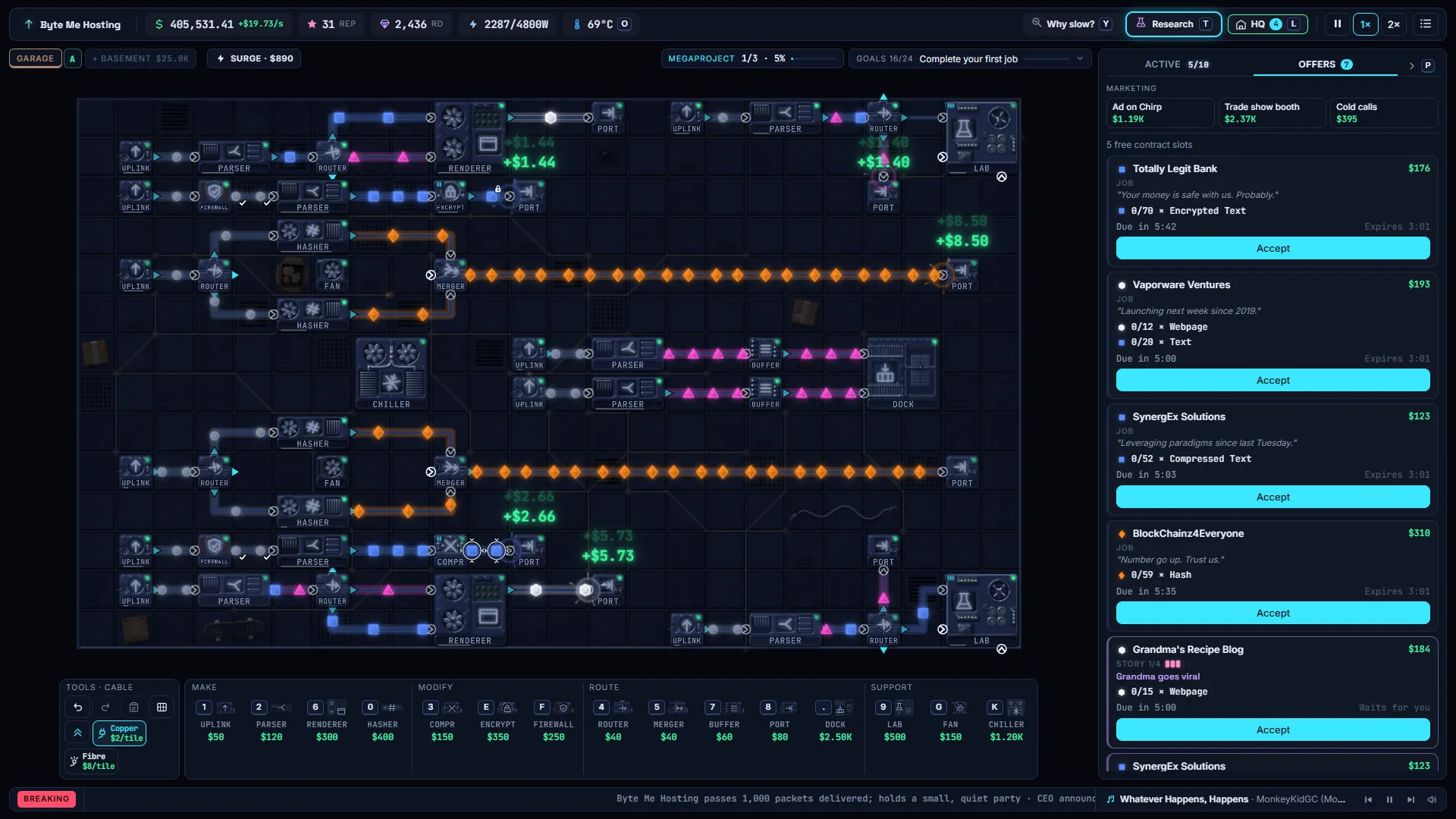
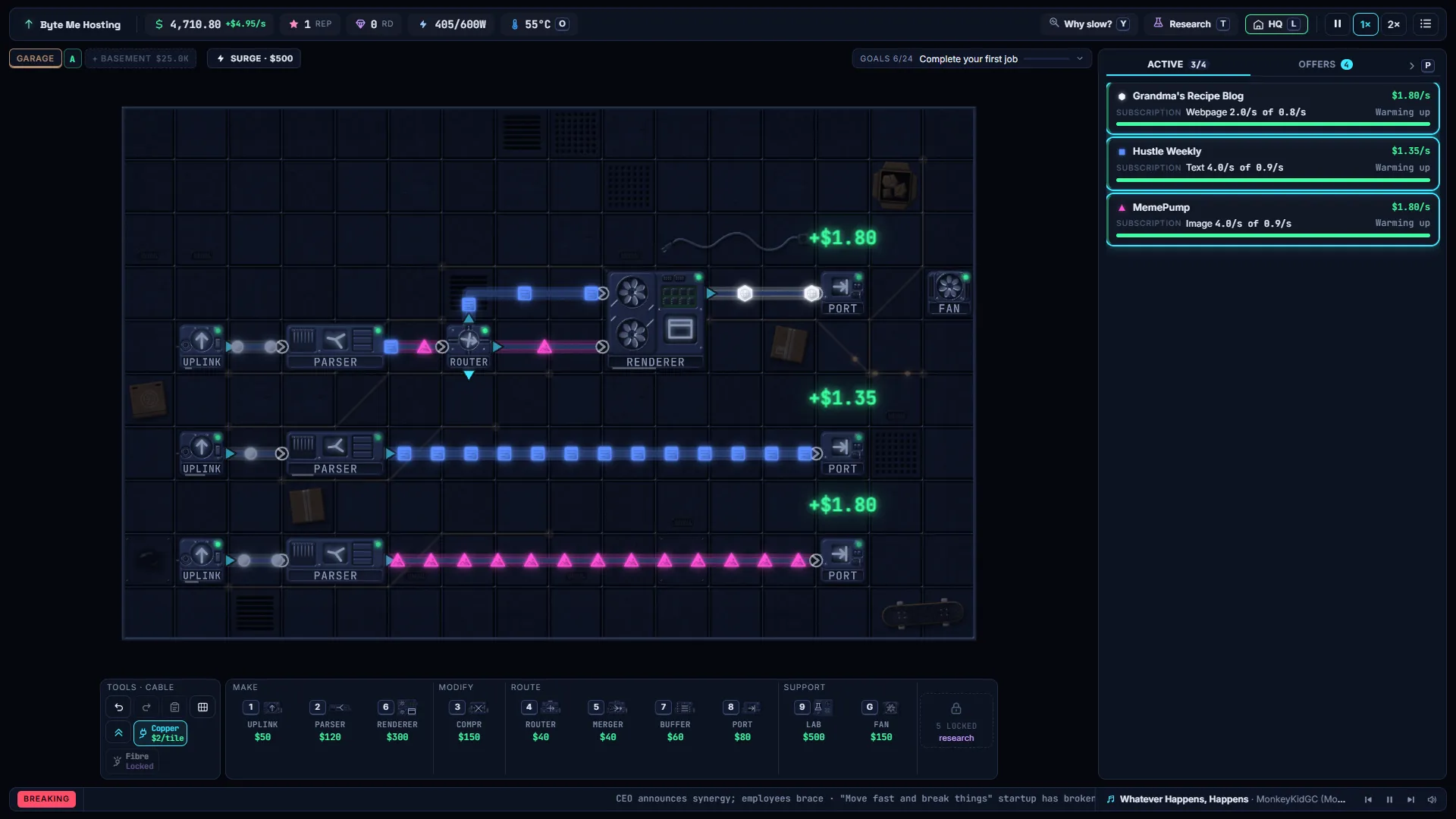
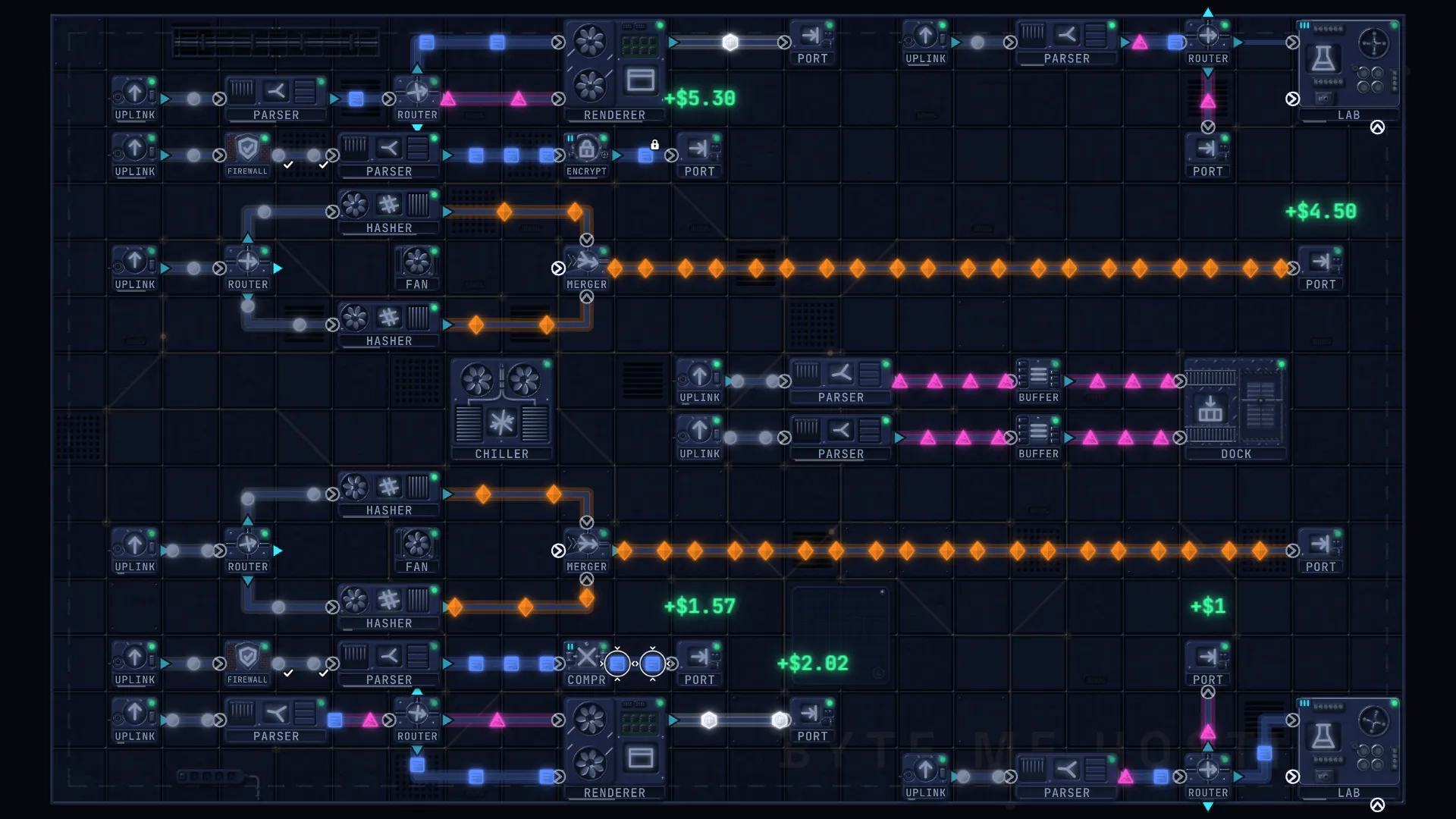
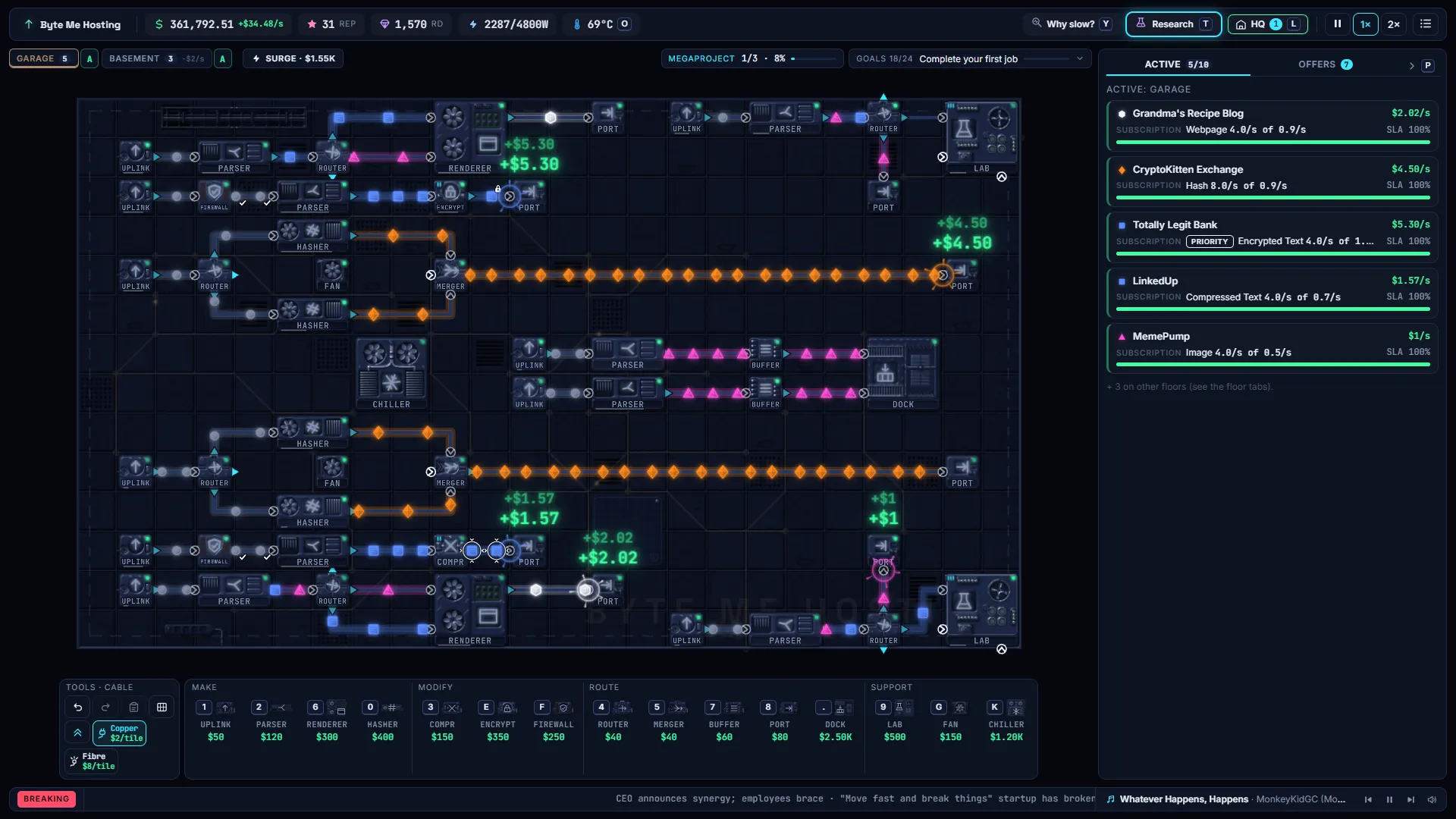
Packet Empire is a data centre tycoon crossed with a top-down factory game, and as far as I know it’s the only factory take on this fantasy. It isn’t out yet. Early Access is planned for 2027, and a free demo (the lit room and the first ring of the building, about 75 minutes, with your save carrying over to the full game) arrives with the Steam page.
Instead of walking the aisles, you look down on a grid. You place machines, drag cables between them, and glowing data packets stream through: an Uplink pulls in Raw requests, a Parser turns them into Text and Image, a Renderer combines the two into Webpages, a Hasher makes Hashes, and Delivery Ports send the lot to clients who pay by the packet. Routers split traffic, Mergers join it, and Compressors and Encryptors add value on the way.
So the puzzle is throughput, not cabling: why is this line backing up, where should the Router go, how do I feed two Renderers from one Parser. The data centre parts are all there, just as systems rather than chores. There’s power, bandwidth and heat, with per-machine temperatures, a heat overlay and Desk Fans and Chillers to fix your hot spots. Machines that overheat break down, but a repair is one click and nothing is ever destroyed. Clients come back with bigger, harder contracts, from exact mixes of packets to rates you have to hold on an SLA meter, all against a deadline, and market events like a DDoS wave make you rethink where your Firewalls go.
It’s also gently silly. Every client is fictional: Grandma’s Recipe Blog wants webpages, and one day a cookbook, Totally Legit Bank wants encrypted text (“Your money is safe with us. Probably.”), and Your Cousin’s Startup is “like Uber, but for text files”. You start in the one lit room of a bankrupt dot-com’s data centre and power up the dark halls section by section, and an office cat naps on your warmest machine.
If you like the theme of this list but prefer routing and throughput puzzles to cabling racks by hand, have a look at the Packet Empire page or the beginner’s guide. And if the factory side is the part that appeals, my lists of cosy factory games with no combat and games like shapez are the natural next stop.